Ask a team that has rolled out AI for incident response how it is going and you will usually hear good news. Fewer pages, faster triage, known problems fixed before anyone wakes up. All of that is real. The harder question is what happens to the engineers on call when the AI is handling most of the work.
An essay from SigNoz's newsletter, "AI isn't replacing SREs, it's deskilling them", resurfaced in engineering circles this week and puts that question plainly. If people only see the rare, strange incidents that the AI cannot handle, when do they build the skill to handle them?
What is the "irony of automation"?
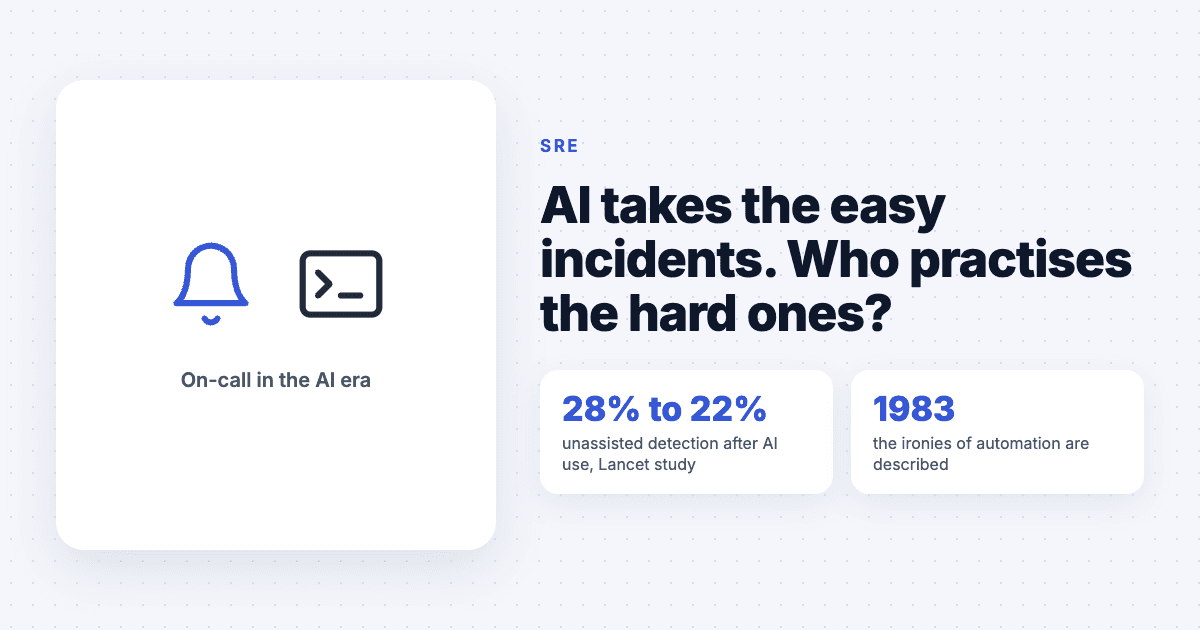
The idea is older than cloud computing. In 1983, the researcher Lisanne Bainbridge described what she called the ironies of automation. The more of a process you automate, the more important the human becomes when the automation fails, and the less practice that human gets. People are left with long stretches of watching, broken by rare emergencies they are no longer ready for.
Incident response is following the same path. Alert grouping, runbook execution, log anomaly detection and fixes for known failures such as restarting a pod are already handled by tools in many teams. Root-cause suggestions, automated rollbacks and change risk scoring are close behind. What is left for people is the novel, cascading failure, which is exactly where judgement and a deep picture of the system matter most.
Is there evidence that this actually happens?
Most of the evidence comes from other fields, and the essay is open about that. The examples it cites include:
Medicine. A study in The Lancet found that endoscopists who had been using AI to spot polyps detected fewer on their own afterwards, with the unassisted detection rate falling from 28% to 22%.
Aviation. Research on long-haul pilots who rely heavily on autopilot shows losses in manual flying skill and awareness of what the aircraft is doing. Regulators responded by requiring pilots to log manual flying time.
The SRE version is easy to picture. Engineers stop reading raw logs because the tool summarises them. They stop forming their own theories because the tool proposes a root cause. They stop building a mental map of the system because the tool draws the dependencies. Each step looks like a productivity gain. Together, they remove the practice that made people good at this work.
It hits junior engineers hardest. They may never build the skills in the first place, because the easy incidents they used to learn on are now handled before they see them.
It is worth noting that SigNoz sells observability tools, including AI features. Its argument is not against AI. It is for using it deliberately.
How do you keep on-call engineers sharp?
Run some incidents by hand on purpose. Pick a share of low-risk incidents, including ones the AI could solve, and have an engineer work them without it. Treat it like the manual flying hours pilots have to log.
Ask for a theory before showing the AI's answer. In reviews and drills, have the responder write down what they think is wrong before they read the AI's root-cause suggestion. Then compare.
Keep people in the loop, not beside it. Clicking "approve" on an AI fix is not the same as understanding it. Make the responder explain why the fix is right before it runs on anything important.
Hold game days for the incidents AI cannot handle. Practise the cascading, multi-system failures your tools have never seen, with the AI switched off for part of the exercise.
Give juniors the easy incidents again. Route a portion of routine pages to newer engineers, with a senior shadowing, so they learn on problems that are safe to get wrong.
None of this means turning the tools off. It means deciding, as a leadership choice, how much speed you are willing to trade today for people who can still fix things when the tools are wrong.
Quick answers
Does AI incident response deskill SREs?
It can. When AI handles routine triage and known fixes, engineers get less practice at reading logs, forming hypotheses and understanding system dependencies, which are the skills needed for rare, novel incidents. Evidence so far comes mainly from aviation and medicine rather than SRE-specific studies.
What are the ironies of automation?
A 1983 idea from Lisanne Bainbridge: the more a process is automated, the more critical the human becomes when automation fails, and the less practice that human gets to handle the failure.
How can teams keep incident response skills sharp?
Work some low-risk incidents without AI, ask responders for their own theory before showing the AI's suggestion, run game days for novel failures, and route routine pages to junior engineers with senior support.