When a critical GitLab fix comes out, most teams do the same thing. They bump the version, roll it out and close the ticket. Alpine Linux did that twice in October and was still exposed, because the part that actually fixed the bug was not in GitLab at all.
Alpine's incident write-up is short, honest and worth reading for anyone who runs GitLab, or any large application, from their own container images.
What was the vulnerability?
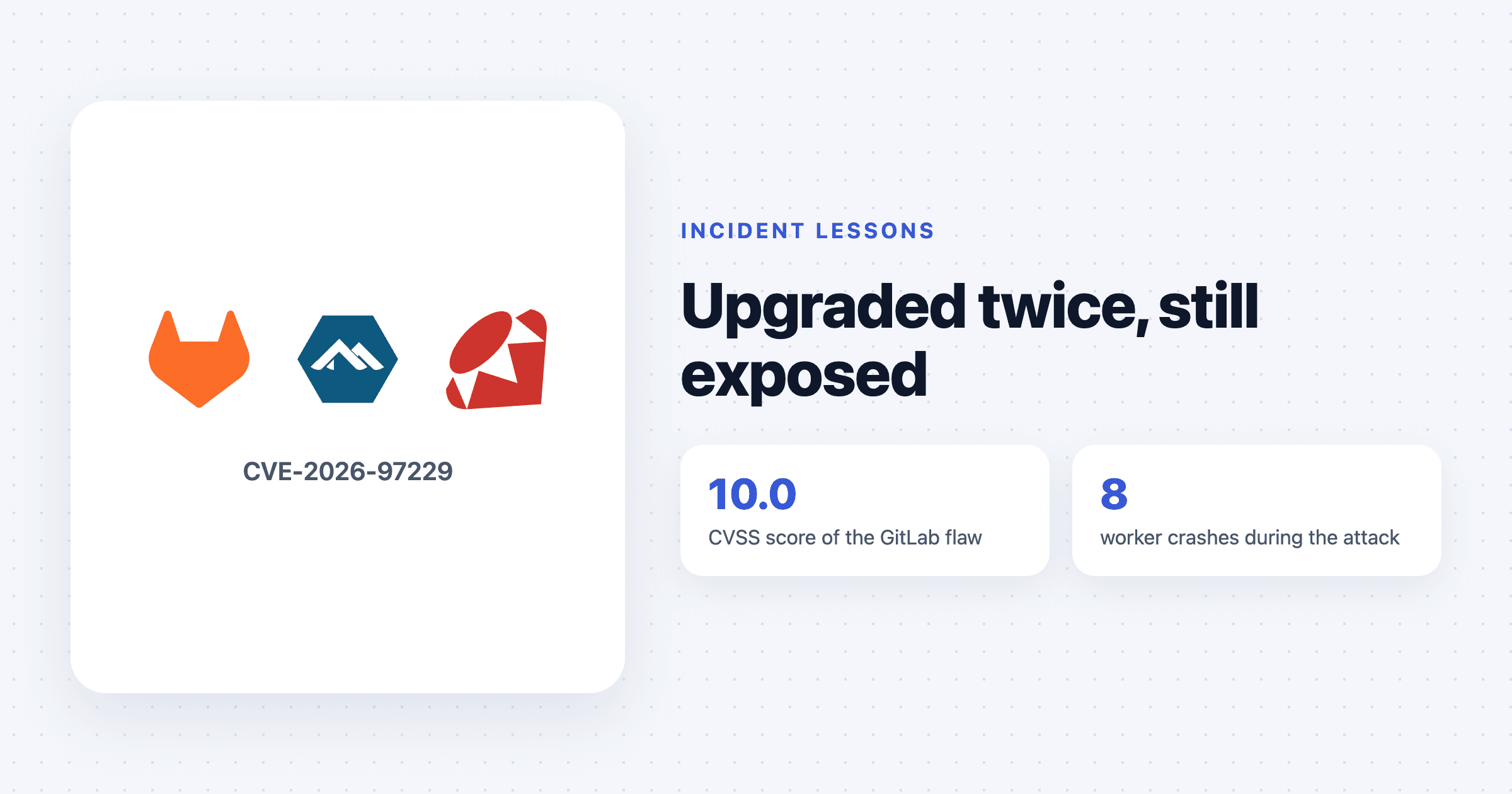
CVE-2026-97229 is a critical remote code execution flaw with a CVSS score of 10.0. It sits in Onigmo, the regular expression engine inside Ruby, and GitLab reaches it when it evaluates regular expressions in CI configuration. It is on CISA's Known Exploited Vulnerabilities list.
GitLab's fix was a patch to Ruby that it applies only in its own packages. Alpine's GitLab container image used the standard Ruby from the distribution, which did not have that patch. So upgrading the GitLab application on Alpine's image changed nothing about the vulnerable code.
How did the incident unfold?
12 October: GitLab released the fix.
13 October: Alpine upgraded, but to 19.3.4 by mistake rather than 19.3.5.
20 to 21 October: An attacker registered an account and started probing. The main attack crashed GitLab workers eight times, causing 502 errors and failed CI jobs.
22 October: Alpine upgraded to 19.3.6, which still did not fix it on their image.
23 October: The attacker was blocked, and Ruby published the upstream fix.
25 to 26 October: The attacker came back and failed. Alpine realised it was still vulnerable.
27 to 29 October: GitLab was closed to everyone but developers and build servers, rebuilt from scratch with every password and secret key reset, and reopened on 19.3.7.
Alpine found no evidence that code ran on the server, and it verified that its package repository, packages and 21 October releases were not tampered with. Signing keys were never on the GitLab server. It also says plainly that a successful exploit would leave no trace in web logs and some logs from the attack day are missing, so it cannot fully rule compromise out. That is why it rebuilt.
What could have been exposed?
Alpine lists it: user emails, names, IP addresses, password hashes, two-factor secrets, CI/CD variables, runner tokens, integration credentials, personal access token hashes and private repositories and issues. For most companies, a GitLab server holds the keys to production. That is the real reason to treat this class of bug as an emergency.
What should self-hosted teams check?
Read the fix, not just the version number. For critical releases, check whether the fix lives in a bundled component such as Ruby, OpenSSL or a database client. If you build your own image, you must carry that patch yourself. For this bug, that means Ruby 3.3.13, 3.4.12, 4.0.9 or later.
Prefer vendor images for complex apps unless you have the time to track their component patches. Rolling your own saves a few megabytes and costs you this kind of gap.
Patch exposed CI and source servers within a day. Alpine has adopted exactly that rule for critical GitLab releases.
Keep logs longer and log outbound connections. Alpine's 14-day retention and missing logs are the reason it cannot be sure. Log outbound and database connections from your GitLab host.
Restrict sign-up on internet-facing instances. The attacker started by registering an ordinary account.
Plan the rebuild before you need it. Know how you would reset every password, runner token and CI variable in a day.
Quick answers
What is CVE-2026-97229?
A critical remote code execution vulnerability with a CVSS score of 10.0 in Onigmo, Ruby's regular expression engine, which GitLab reaches when evaluating regular expressions in CI configuration.
Why did upgrading GitLab not fix CVE-2026-97229 on Alpine?
GitLab's fix was a patch to Ruby that it ships only in its own packages. Alpine's GitLab image used the distribution's standard Ruby, which lacked the patch, so newer GitLab versions on that image stayed vulnerable.
Which Ruby versions fix CVE-2026-97229?
Ruby 3.3.13, 3.4.12 and 4.0.9 or later include the fix. Self-hosted GitLab users who build their own images need one of these versions as well as an updated GitLab.