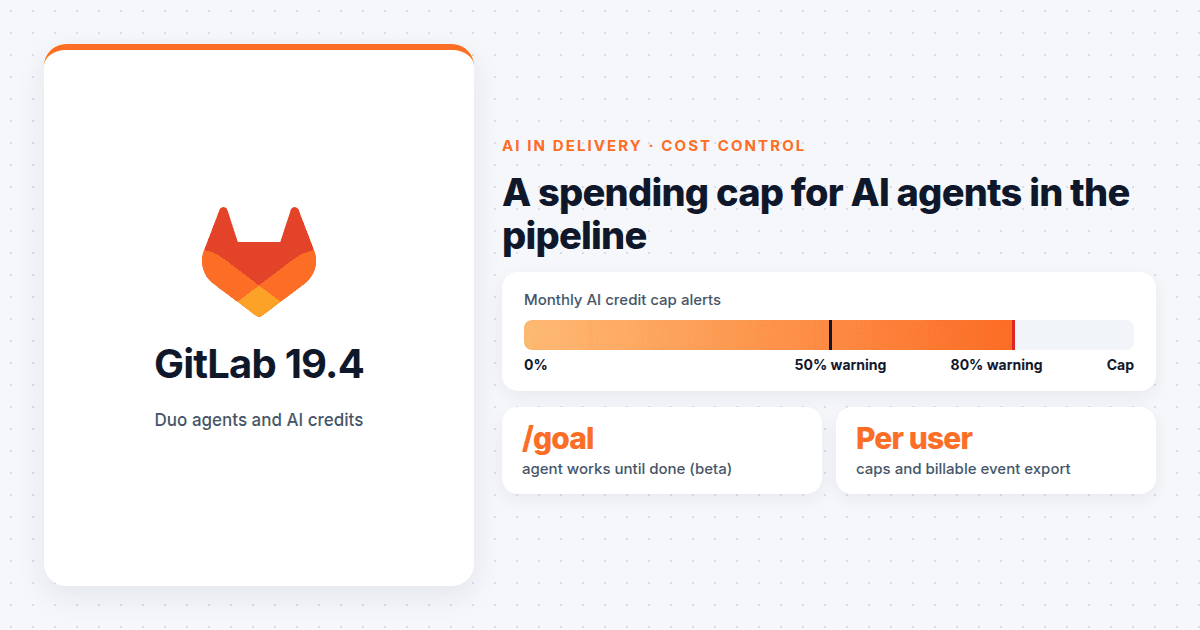
GitLab 19.4 came out in mid-September, but it only started getting attention this week, and most of the coverage has focused on the flashy part. The new /goal command in GitLab Duo CLI lets you hand an agent an open-ended objective and walk away. It keeps going until the job is done or it hits an iteration limit. One model makes the changes and a second model checks progress against the goal.
That is genuinely interesting. It is also in public beta, needs Premium or Ultimate, and will need a few months of real use before anyone knows how often it finishes the job well.
The quieter changes are the ones we would pay attention to first.
AI spend finally gets a budget line
GitLab now shows a row for every billable AI event: which user, which project, which session, which type of flow, how many credits and how many tokens. Group owners can set a default cap per user and override it for individuals without touching the API. Billing managers get a warning when on-demand usage hits 50% and again at 80% of the monthly cap. These cost features are generally available, not beta.
If you have tried to answer "how much are we spending on AI in our engineering tools, and who is spending it" in the last six months, you know why this matters. Most teams can't answer it. The spend is spread across seats, credits, API keys and a few personal cards, and the first time anyone looks is when finance asks.
Agents that loop until they hit a goal make this worse. An agent that retries a failing task forty times overnight is the AI version of a runaway autoscaling group.
Cheaper models, with an asterisk
GitLab also added three hosted open-weight models: Kimi K3, MiniMax M3 and GLM 5.3. GitLab says they give up to four times as many calls per credit as many frontier models. It did not publish benchmarks or per-call prices, so treat that as a claim to test. Owners can choose a default model for each feature and restrict which models teams may use, which is a useful control for anyone with data rules about where code can be sent.
Agents get more reach
The GitLab MCP server now exposes more tools to outside agents: pipelines, merge requests, work items, repositories and vulnerabilities. By default, read actions are approved automatically and anything that writes or deletes needs a human to approve. Keep those defaults. Loosening them is the kind of change that seems fine until an agent closes 200 issues it misunderstood.
Where we would start
Turn on the credit caps before you turn on goal mode. Export a month of usage and look at the top ten users and projects. You will probably find a couple of surprises, either heavy users who are getting real value and need a higher cap, or automation that nobody remembers setting up.
Then have the conversation with finance while the numbers are still small. AI in the delivery pipeline is going to become a real cost line, and it is much easier to agree who owns it at a few thousand dollars a month than after the first five-figure invoice.