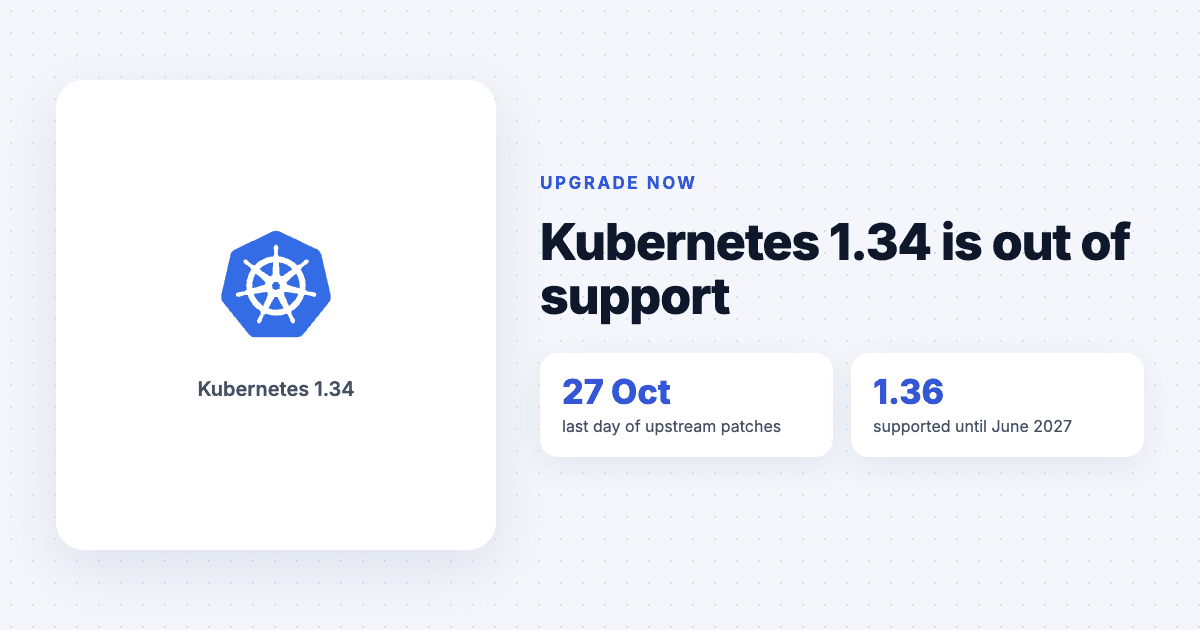
Kubernetes 1.34 reached end of life on 27 October 2026. From now on the upstream project will not ship any more patches for it, including security fixes. The last release on the branch is 1.34.12.
According to the Kubernetes releases page, the supported versions are now 1.37, 1.36 and 1.35. If your clusters are still on 1.34 or older, the safe move is not the smallest step. Version 1.35 itself goes out of support on 28 February 2027, so an upgrade that stops there buys you about four months before you have to do it again.
Which Kubernetes versions are supported now?
1.37: latest patch 1.37.1, supported until 28 October 2027.
1.36: latest patch 1.36.5, supported until 28 June 2027.
1.35: latest patch 1.35.9, supported until 28 February 2027.
1.34: final patch 1.34.12, end of life on 27 October 2026.
Upstream end of life is not the same as your cloud provider's end of support, but it is the date after which nobody upstream is fixing new problems in that version. Any fix your provider ships after that point is its own backport.
What does this mean on EKS, GKE and AKS?
Managed services run their own calendars. On Amazon EKS, 1.34 stays in standard support until 2 December 2026 and then moves to extended support until 2 December 2027, according to endoflife.date. Extended support costs extra for every cluster hour, so a cluster left on 1.34 into December starts costing more for the same thing.
GKE and AKS publish their own version schedules and auto-upgrade rules. If you rely on auto-upgrade, check which release channel each cluster is on and when its next forced upgrade is due, so the timing is yours rather than the provider's.
Why aim for 1.36 instead of 1.35?
Control plane upgrades go one minor version at a time, so a 1.34 cluster has to pass through 1.35 on the way to anything newer. The question is where to stop.
Stopping at 1.35 leaves you with an end-of-life date in February 2027, which means repeating the whole exercise over the holidays and into the new year. Going on to 1.36 gives you support until June 2027 and keeps you one version behind the newest release, which is where most production teams want to be. Version 1.37 is the newest release and some managed services and add-ons have only recently added support for it, so unless you need something it adds, plan for it as your next step rather than this one.
How to run the upgrade without surprises
Inventory every cluster. Include test, edge and forgotten clusters. A version spreadsheet that nobody updates is how a 1.33 cluster survives into 2027.
Check for removed or changed APIs. Run a deprecated API scanner against your manifests and Helm charts, and read the 1.35 and 1.36 changelogs for anything your controllers depend on.
Check add-on compatibility first. CNI, CSI drivers, ingress controllers, service mesh, policy engines and autoscalers each have their own supported Kubernetes versions. These break upgrades more often than Kubernetes itself does.
Test drain behaviour. Make sure PodDisruptionBudgets allow nodes to drain. A budget that allows zero disruptions will stall a node pool upgrade halfway through.
Upgrade clients too. Update kubectl, CI runner images and any tool that talks to the API server, so engineers are not using a client that is several versions behind.
Go one version at a time and watch between steps. Upgrade to 1.35, let it run for a few days with normal traffic, then continue to 1.36.
If you missed this deadline, you are not alone. Kubernetes ships three minor releases a year, and each is supported for about fourteen months. Teams that upgrade twice a year as a routine job tend to find the work small. Teams that wait for an end-of-life date tend to find it large.
Quick answers
When did Kubernetes 1.34 reach end of life?
Kubernetes 1.34 reached end of life on 27 October 2026. The final patch release on the branch is 1.34.12, and the upstream project no longer ships fixes for it.
Which Kubernetes versions are supported in November 2026?
Kubernetes 1.37 (supported until 28 October 2027), 1.36 (until 28 June 2027) and 1.35 (until 28 February 2027). The latest patches are 1.37.1, 1.36.5 and 1.35.9.
Does Amazon EKS still support Kubernetes 1.34?
Yes, for now. EKS standard support for 1.34 runs until 2 December 2026, followed by paid extended support until 2 December 2027, which adds a charge for every cluster hour.