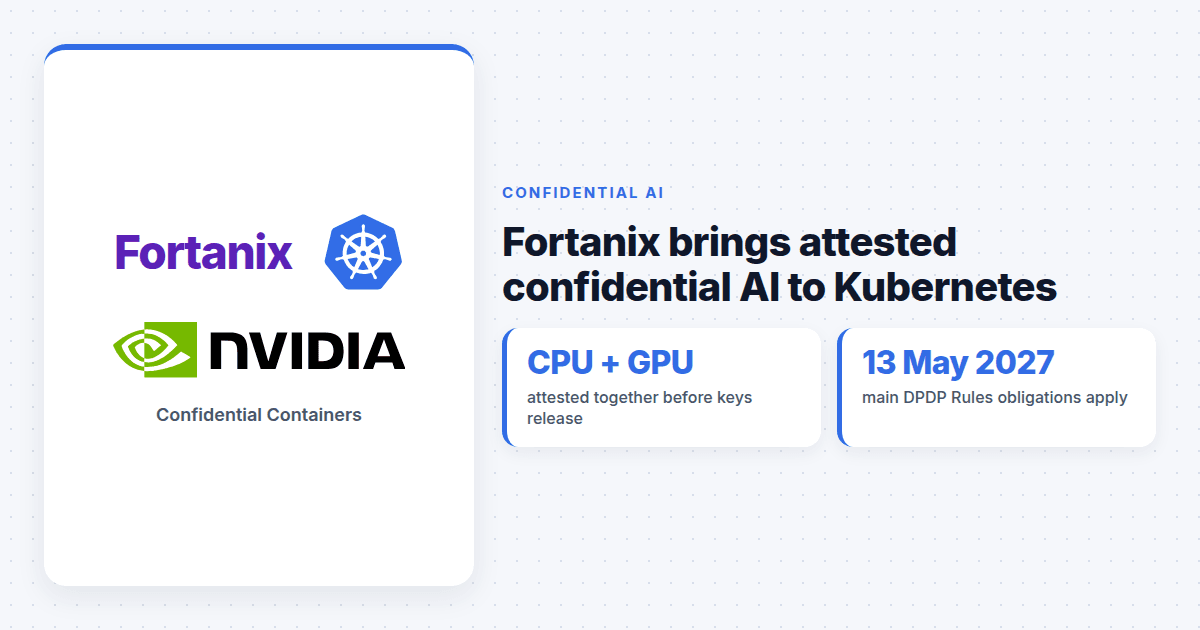
Fortanix said on 18 October that its Confidential AI platform now supports Confidential Containers, the CNCF project that runs Kubernetes pods inside hardware-protected memory. The pitch is that enterprises can run AI inference on Kubernetes without the cluster operator, the cloud provider or a rogue admin being able to read the model or the data it is processing.
Confidential Containers wraps each pod in a small confidential virtual machine backed by CPU features such as Intel TDX or AMD SEV-SNP, and hands over decryption keys only after the hardware proves what is running. Teams in healthcare, financial services and government that process regulated data on shared or third-party infrastructure are the ones who should look at it. Fortanix said the product is available now.
What did Fortanix announce?
According to the Fortanix release, its Confidential Computing Manager attests the CPU and GPU together before any data or model is decrypted. Its Data Security Manager, a FIPS 140-2 Level 3 HSM, then releases keys only if that attestation meets the customer's policy, and only into the protected environment. Fortanix said open source plugins that connect its products to the Confidential Containers runtime are in development.
The platform can run as SaaS, on-premises or fully air-gapped. Nvidia, Intel, AMD, Red Hat, Cisco and Rafay were among the partners named, and Fortanix and Cisco demonstrated it at Nvidia GTC Berlin from 20 to 22 October.
Fortanix also cited a survey it commissioned from Atomik Research of 300 AI leaders at large US companies. According to SiliconANGLE, 93% said traditional encryption does not protect data during AI processing, and 41% had blocked an AI deployment over security concerns. CEO Anand Kashyap said moving AI into containers "doesn't change the threat."
What are Confidential Containers, in plain terms?
Most teams already encrypt data on disk and on the network. The weak spot is memory. While a model is running, its weights and your prompts sit in memory in the clear, and anyone with enough control of the host, such as a hypervisor admin, a cloud operator or an attacker who owns the node, can in principle read them.
Confidential computing hardware closes that gap. The CPU encrypts a virtual machine's memory with keys the host never sees. Newer Nvidia GPUs extend the same protection to GPU memory.
Confidential Containers, often shortened to CoCo, brings this to Kubernetes. Each pod runs in its own confidential VM, so your manifests barely change. A component called Trustee handles attestation, which is the hardware's signed proof of what software is running, and releases secrets only when that proof checks out. The project supports Intel TDX, AMD SEV-SNP and IBM Secure Execution, plus Nvidia Hopper and Blackwell GPUs. On public cloud it supports Azure and Google Cloud today, with AWS listed as under development.
CoCo joined CNCF on 8 March 2022 and moved to incubating status on 8 July 2026.
Cisco described the flow for the GTC Berlin demo in five steps:
The model owner packages the model as an encrypted image, with the keys held in Fortanix DSM.
The enterprise deploys the workload on a confidential VM or through CoCo with Kata Containers.
Fortanix CCM checks attestation evidence covering the CPU, GPU and software.
DSM releases the keys into the verified environment, and the model serves prompts inside it.
If the image, configuration or measurements change, key release fails and the workload cannot start.
That last step is the one auditors will like. Tampering does more than raise an alert. It stops the workload from decrypting anything.
When should regulated teams care?
Three situations make the case. You run AI on GPUs you do not own, such as a public cloud or a GPU rental provider. You host a vendor's proprietary model next to your own sensitive data, and neither side wants the other to see its half. Or you share a cluster across business units that are not allowed to see each other's data.
For Indian teams, the timing lines up with the DPDP Act. The DPDP Rules were notified on 13 November 2025, and the main obligations on data fiduciaries, including security safeguards, apply from 13 May 2027. Rule 6 asks for reasonable safeguards and names measures such as encryption, masking, obfuscation and access control. Breaches have to be reported within 72 hours.
The law does not require confidential computing. But if a health or lending platform plans to send patient or borrower data through an AI model on someone else's hardware, CoCo gives a clear answer to the question of who can see that data while it is being processed.
If you own the hardware, trust your admins and keep the data in-house, the extra moving parts may not be worth it yet. Attestation and key release become part of your production path, and if they fail, your workload does not start.
Expect the first adopters to be banks and hospitals running third-party models. Everyone else will wait to see how much operational work the attestation piece really adds.
Quick answers
What are Confidential Containers?
Confidential Containers is a CNCF project that runs each Kubernetes pod inside a small confidential virtual machine, protected by CPU features such as Intel TDX or AMD SEV-SNP. The host and its administrators cannot read the pod's memory, and secrets are released only after the hardware proves what is running.
Does India's DPDP Act require confidential computing?
No. Rule 6 of the DPDP Rules asks for reasonable security safeguards such as encryption, masking and access control, with the main obligations applying from 13 May 2027. Confidential computing is one way to protect personal data while it is being processed, not a legal requirement.
Is Fortanix Confidential AI for Confidential Containers available now?
Yes. Fortanix said on 18 October that it is available now, as SaaS, on-premises or fully air-gapped, with open source plugins for the Confidential Containers runtime still in development.