Ask a platform team at any company that went all in on event-driven design a few years ago to draw their EventBridge setup. You will usually get a whiteboard full of buses, rules forwarding events between accounts, Lambda functions doing small transformations, and a shrug when you ask who subscribes to what.
AWS has clearly heard the same story. On 24 September it relaunched EventBridge custom event buses as a new, enhanced version. InfoQ covered it this week, and one AWS engineer called it the biggest EventBridge launch since the service first came out in 2019.
What is new
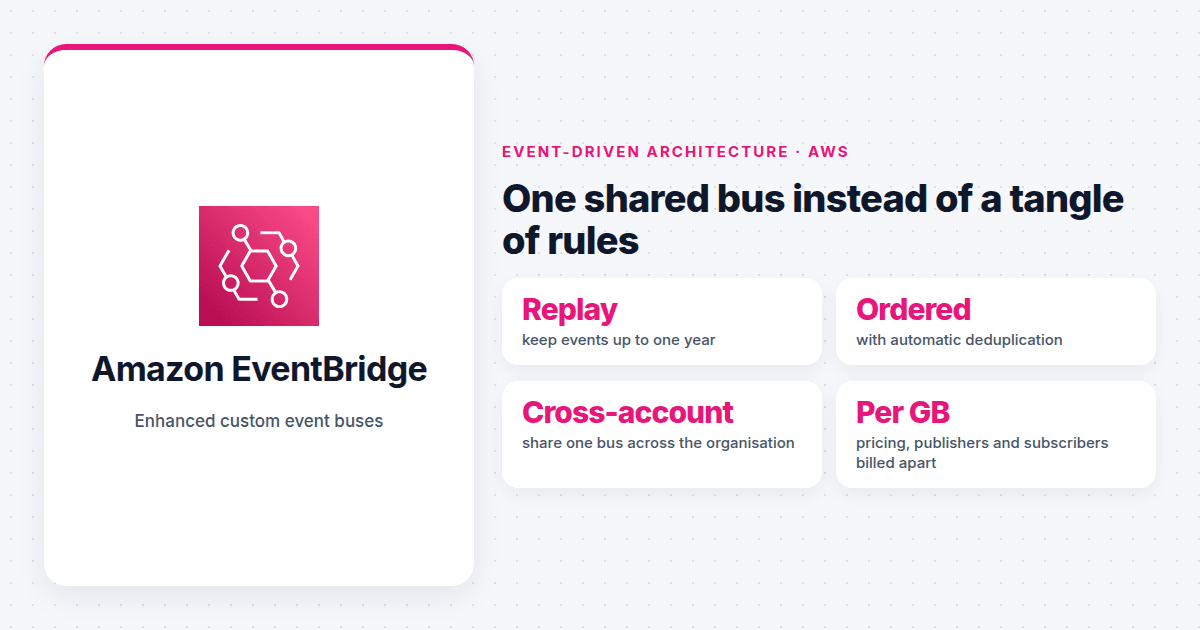
The new bus can be shared across accounts using AWS Resource Access Manager, so many teams can publish straight into one central bus instead of forwarding events through chains of rules. It keeps events for 24 hours by default and up to a year, which means you can replay history to recover from a bug or to feed a brand new service.
It supports strict ordering and automatic deduplication by content. It can transform events with JSONata, so a lot of those small "reshape this payload" Lambda functions can go. It accepts formats like CloudEvents as is, and supports Avro and Protobuf.
The new Subscriber resource bundles filtering, targets, retries and dead-letter handling in one place. That also fixes the visibility problem. Platform teams can finally see who is listening to which events.
Pricing has changed shape too. You now pay for data moved rather than events, and publishers and subscribers are billed separately. Corey Quinn put ingest at roughly 18 cents per GB and called it high but reasonable for normal use. It is worth modelling against your real traffic before you assume it is cheaper.
The old buses are untouched and now called "classic". The enhanced bus is a separate resource, and AWS has not offered a migration path. Mumbai is one of the 14 launch regions, which is good news for Indian teams.
Is it worth moving?
If your event setup is one account and a few rules, probably not yet. If it spans dozens of accounts and teams, and you have built your own ordering, dedup or replay on top of EventBridge, this could let you delete a surprising amount of code.
Ordering and deduplication matter more than they sound. When we published our piece on running AI claims processing at scale, the hardest problems were duplicates, processing claims twice, and putting parallel results back together in the right order. Having the bus handle some of that does not remove the need for idempotent consumers, but it shrinks the number of ways things can go wrong.
A sensible first step is to pick one cross-account flow that causes pain today and rebuild it on an enhanced bus in a test account. Measure the bill, try a replay, and see how many forwarding rules and glue functions you can switch off.