You know the Well-Architected review. Someone books two afternoons, a spreadsheet fills up with questions, half the answers are "it depends", and the action items live in a wiki page nobody opens again. AWS now thinks an agent can do that job, or at least the boring part of it.
The AWS Well-Architected Agent, announced in preview on 1 October 2026, is an AI service that checks your AWS environment and your infrastructure as code against Well-Architected best practices and hands back prioritised fixes. It is aimed at customers with an AWS Support plan. It is good at finding and ranking problems. Deciding which trade-offs your business accepts is still your job.
What does the AWS Well-Architected Agent do?
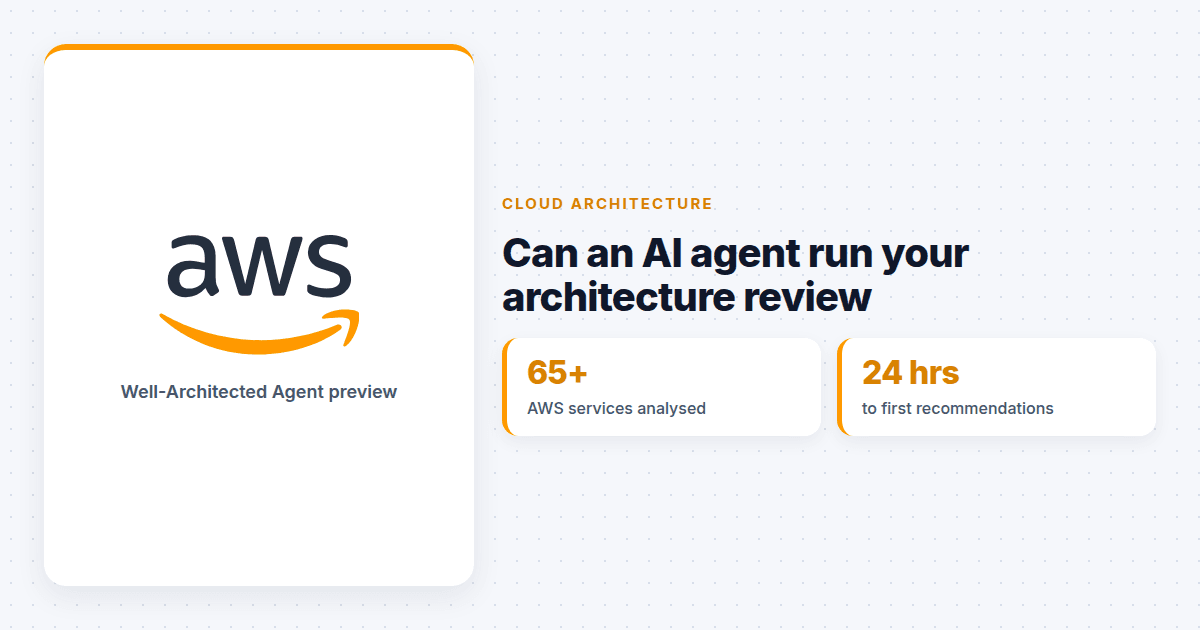
AWS calls it the next generation of Trusted Advisor and the Well-Architected Tool. You create an agent profile that sets which accounts and regions to watch, which pillars to focus on and your goals for each one. You give it customer-managed IAM roles to read your environment. Recommendations arrive within 24 hours.
The agent correlates resource configuration, utilisation metrics and application topology. According to InfoQ, it covers more than 65 AWS services across cost, security, performance and resilience.
Findings come at three levels: single resources, applications and broad architecture patterns. Each one shows its reasoning, trade-offs and a fix, delivered as a console walkthrough, AWS CLI commands or updated infrastructure as code. You can also upload a Terraform, CloudFormation or CDK project before deployment and have it reviewed against a chosen lens. APIs and the AWS MCP Server let you call it from pipelines and coding tools.
Where it earns its keep
The grind. Nobody enjoys walking 40 accounts looking for unencrypted volumes, idle instances and single-zone databases. An agent that does this continuously, ranks the results by impact and effort, and attaches a dollar figure where it can is worth having.
The pre-deployment review is the more interesting part. Catching a public bucket or a missing backup policy in a Terraform pull request is cheaper than catching it in production. If the agent's output lands as a comment on the change, it becomes part of normal review instead of a yearly event.
It also helps the teams that never get a review at all. Corey Quinn of The Duckbill Group joked to InfoQ that it reaches customers who cannot get a solutions architect on the phone. Joke or not, that is a lot of customers.
What still needs people?
Business goals, for a start. The agent ranks fixes against the goals you declare. Nicolas Payette of Specira AI asked where those goals come from, since most companies never wrote down whether a workload should trade cost for resilience. If you feed it vague goals, you get confident advice tuned to nothing.
Trade-offs are the second gap. Alex Kargin of Silicon Army warned about jumping from recommendation to automated fix when every optimisation costs something elsewhere. Moving to a single zone saves money. It also changes your outage story.
Then there is context the agent cannot see: a contract that requires data to stay in one region, a migration planned for next quarter, a team that cannot support another managed service. And accountability. AWS itself says the output may contain errors or gaps and that you are responsible for reviewing it. That is the catch.
Who can use it?
The agent is reached from US East (N. Virginia), US East (Ohio) and US West (Oregon), but can onboard workloads from any AWS commercial region. AWS Support delivers it, and InfoQ reported it requires Business Support+ or higher. AWS has not published preview pricing.
How to try it without regret
Write down goals per application before you create the profile. Cost first or resilience first, and how much downtime is acceptable.
Start with one application you know well, and compare the agent's findings with your last manual review.
Scope the IAM roles you grant it, and review them like any other third-party access.
Send every suggested infrastructure change through your normal pull request process. No direct console fixes.
Can an agent run your architecture review, then? It can run the checklist. The review was always about the arguments, and those still need people in the room.
Quick answers
What is the AWS Well-Architected Agent?
It is an AI service in preview that checks your AWS environment and infrastructure as code against Well-Architected best practices and returns prioritised recommendations with fixes.
Who can use the AWS Well-Architected Agent?
Customers with an AWS Support plan. InfoQ reported it needs Business Support+ or higher. It is accessed from three US regions but can onboard workloads from any commercial region.
Does it replace the Well-Architected Tool?
No. AWS said the existing Well-Architected Tool stays available for manual reviews with custom lenses.