Every data centre has a backup plan for losing grid power. The batteries carry the load for a few minutes, the generators start, and nobody outside the building notices. On 20 October in London, the batteries did their job and the generators never got the signal to start.
Google published its incident report on 4 November. It is one of the more useful outage reports of the year, because the root cause is physical but most of the damage came from how software reacted.
What happened in europe-west2?
An underground cable fault cut feed A, one of two utility feeds to a data centre serving zone europe-west2-b. Feed B was already isolated for planned maintenance. That should have been the moment the generators took over.
They did not, because the control system was confused. The sensors that watch for low voltage were wired upstream of the feed breakers. They could still see live voltage on feed B, even though its breaker was open and it was supplying nothing. The controller decided a healthy source was available and never sent the start command. Both redundant controllers ran the same logic, so both made the same mistake.
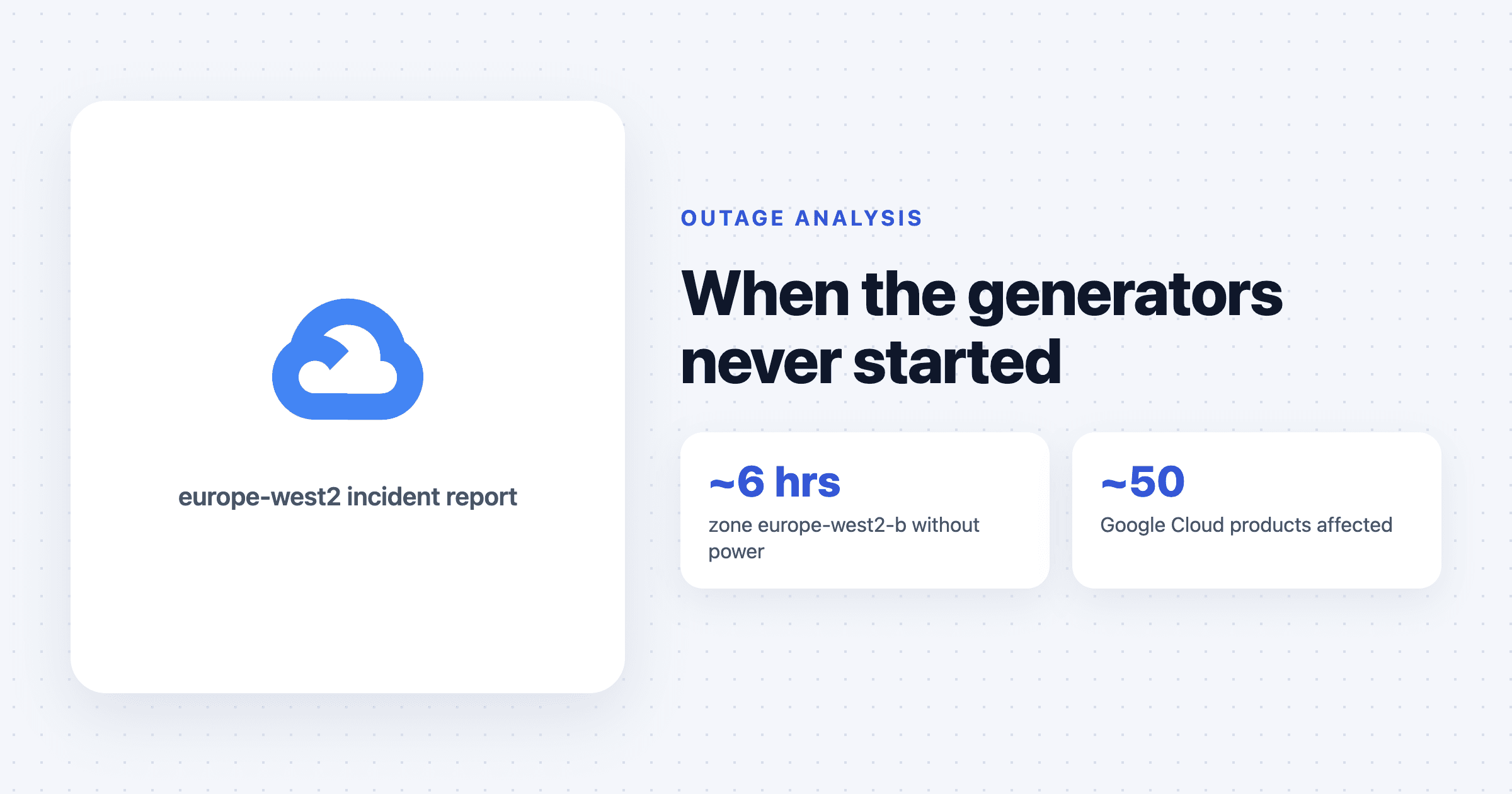
The UPS batteries lasted about five minutes. Then the zone went dark. Google's report puts the impact at about six hours and eight minutes, starting at 07:00 UK time.
Why did one zone hurt the whole region?
This is the part cloud customers should read twice. Google says there was no impact outside europe-west2, and two of the three zones kept power. Yet roughly 50 products reported problems, including Compute Engine, GKE, Cloud Run, Cloud SQL, Spanner, BigQuery, Pub/Sub and Cloud Load Balancing.
The report gives three reasons:
Failover ran out of room. Traffic and workloads moved to zones a and c, which then became overloaded. Some Compute Engine failovers failed for lack of capacity.
Hidden cross-zone dependencies. Some control planes depended on components in the failed zone, so requests in healthy zones timed out.
Slow recovery paths. Persistent Disk failover, BigQuery autoscaling and Memorystore control planes were among the areas Google says it is now fixing.
In other words, losing one zone of three is supposed to cost a third of capacity. In practice it caused elevated latency and HTTP 500 and 503 errors across a region.
What is Google changing?
Google has reconfigured and validated the controller logic at the site, frozen maintenance at similar sites and added stricter approval for non-standard configuration changes. It plans to validate the same controllers at similar sites around the world by mid-November and to run generator load tests with both feeds. On the software side, teams are working on faster disk and HA failover, better zonal outage detection and spreading Apigee replicas across zones.
What should customers take from it?
Plan for N minus one zone at full load. If your service needs three zones' worth of capacity to run, it is not zone-redundant. Reserve or pre-provision enough in the remaining zones, because on the day everyone else is trying to fail over too.
Map your managed-service dependencies by zone. A zonal database primary, a regional queue with a zonal control plane or a single-zone cache can take a "multi-zone" app down. Ask your provider, and test it.
Treat maintenance windows as higher risk. Google's site was running on one feed because the other was under maintenance. Your systems are the same. When you take one leg of redundancy out for work, you are running without a spare.
Test the trigger, not just the backup. The generators probably worked fine. The thing that tells them to start did not. In your own world, that is the health check, the failover script or the alert that pages a person.
Physical failures will keep happening. What separates a short blip from a six-hour regional incident is how much spare room and independence the software has when they do.
Quick answers
What caused the Google Cloud London outage in October 2026?
A utility cable fault cut one power feed while the other was isolated for maintenance. The generator controller misread voltage on the isolated feed as available power and never started the generators, so the zone lost power when its UPS batteries ran out after about five minutes.
How long did the europe-west2 outage last?
Google's final report gives about six hours and eight minutes of impact, starting at 07:00 UK time on 20 October 2026.
Why were services in other zones affected?
Failover traffic overloaded the two remaining zones, some failovers failed for lack of capacity, and some control planes depended on components in the failed zone, causing timeouts and errors across the region.