Cloud providers have always offered free help to move workloads onto their platform. Google has now built an AI agent for it, and it is aimed squarely at Amazon's Kubernetes customers.
The agent is part of Google Cloud Modernize, a bundle announced on 5 October that also wraps up Migration Center, VMware Engine and mainframe modernisation. The EKS to GKE piece is in public preview.
What it actually does
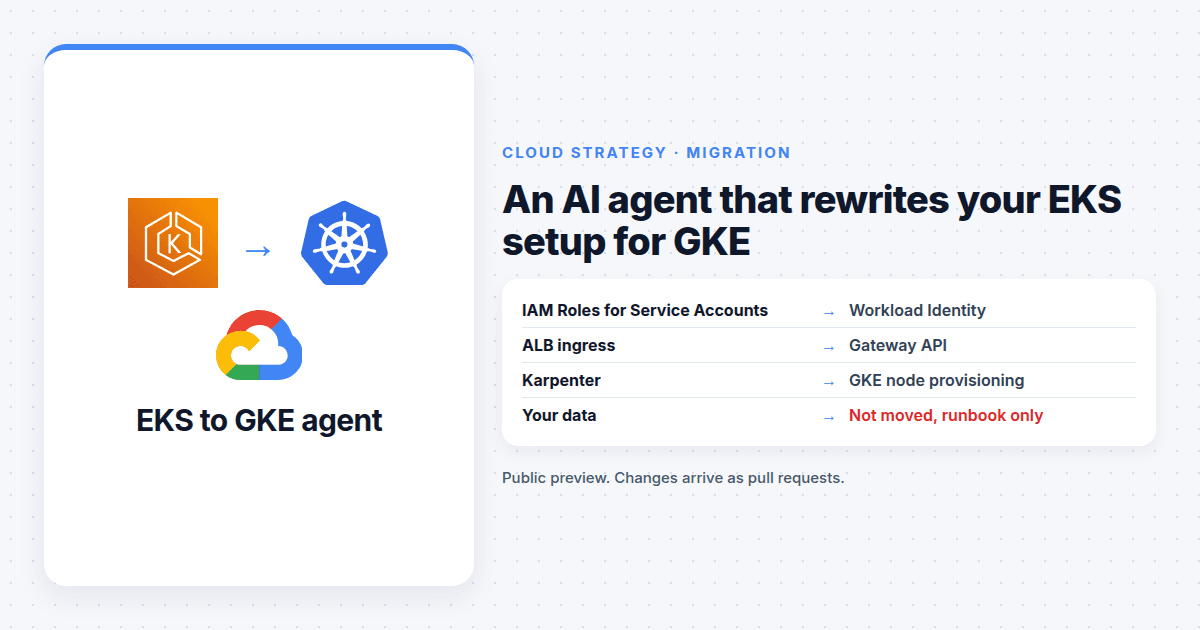
You point it at a cluster or a repository. It scans what is there and translates the AWS-specific parts into their Google equivalents. IAM Roles for Service Accounts become Workload Identity. Application Load Balancer ingress gets mapped to the Kubernetes Gateway API. Karpenter node settings get converted to GKE's own node provisioning. It writes Terraform modules, rewrites manifests, and then opens pull requests rather than touching a live cluster.
That last detail is a good design choice. Changes go through your normal review and CI process, so nobody wakes up to find an AI rebuilt production overnight.
It does not move data. For databases and storage it generates runbooks that point you at Google's Database Migration Service or Storage Transfer Service. Testing, architecture decisions and the final cutover stay with your team. Google has not published pricing.
The honest view
Anyone who has migrated Kubernetes between clouds knows the YAML is the easy part. The hard parts are data, DNS, networking, the twenty internal services with hardcoded AWS endpoints, and the on-call team learning a new platform at 2am. An agent that automates translation removes maybe the first few weeks of a migration. It doesn't remove the last few months.
Still, the first few weeks are where most migrations die in a spreadsheet. If a platform lead can show a working GKE version of a real service in days rather than a quarter, the conversation inside the company changes.
Why this matters even if you never move
The bigger effect is on negotiation. One reason AWS commitments are sticky is that leaving looks expensive and slow. A credible, cheap way to estimate the move changes that. Even a pull request showing your top three services running on GKE is a useful thing to have on the table during your next enterprise discount renewal.
We would not recommend migrating on the strength of a preview tool. We would recommend letting a platform engineer spend a couple of days running it against one non-critical cluster. You will learn how portable your setup really is, which AWS-specific features you depend on without realising, and how much your exit costs. Those are useful answers whether you stay or go.