


The Infrastructure Hiring Report: September 2026
We read 516 live infrastructure job postings from 54 companies. Pay ranges appear in 95 percent of American ads and none of the Indian ones, five roles in the whole sample are open to juniors, and 141 want on-call without pricing it.
- 516
- Postings reviewed
- 54
- Companies
- 58
- Job boards
- 8,900
- Roles screened
Download the full report (PDF)
Sign in or join the community to download.
One hundred and forty-one of the postings we read want you to carry a pager. Not one of them says what that is worth.
That is the kind of thing you only notice when you stop reading job ads one at a time. So we stopped. In September 2026 we went through every role open on 58 company job boards and pulled out the infrastructure ones: 516 postings across 54 companies that were hiring for the roles that sit between DevOps, SRE and platform engineering, plus infrastructure software and cloud security.
This is the first edition of a report we intend to run every quarter. Every number in it comes from a posting that was live on the day we looked, and everything we counted is set out below, including the mistake we made on the way.
Executive summary
Pay transparency is decided by your postcode, not your employer. Ninety-five percent of American postings publish a salary range. India: zero out of 46. The same companies do both, depending on which country the role sits in.
The bottom of the career ladder has gone missing. Senior, staff and principal roles account for 308 of the 516 postings. Junior roles and internships account for five.
On-call is everywhere and priced nowhere. One hundred and forty-one postings mention carrying a pager. None of them mention paying for it.
Kubernetes is the entry ticket, Docker has become invisible. Kubernetes appears in 53 percent of postings, Terraform in 34. Docker sits at 12 percent, which is what happens when a technology stops being a skill and becomes furniture.
AI language is real but smaller than the noise. Forty-two percent of infrastructure postings mention AI in a concrete form. A looser count, of the sort that produces headlines, would have told you 91.
Remote usually has a fence around it. Hybrid is now the largest category. Seventy-six postings advertise as remote and then restrict where you may live.
Methodology
On 25 September 2026 we reviewed the job boards of 58 companies and went through every role they had open, 8,900 listings in all. From those we kept the infrastructure roles, picked out by job title: DevOps, SRE, site reliability, platform engineer, infrastructure, cloud engineer, cloud architect, Kubernetes, observability, release engineer, build engineer, production engineer and developer platform. That left 516 postings across 54 companies, because four of the boards had no infrastructure roles open at all.
For each posting we noted where the job is based, whether it is remote, hybrid or onsite, the seniority in the title, the pay range where the employer published one, any stated years of experience, whether on-call is part of the job, any citizenship or clearance requirement, and which of 52 named technologies the description mentions. Pay figures were taken from the employer's own compensation paragraph.
The limits you should hold us to. These are all boards hosted on the same recruiting platform, which tilts the sample toward American venture-backed technology companies and away from banks, telcos, government and the Indian services industry. It is a snapshot of what was open on one day, not a record of hiring over time. It is concentrated: Elastic, Anthropic and Cloudflare account for 146 of the 516 postings between them, so a single percentage point can move on one employer's house template. Where a posting lists several locations we counted the first one. And our AI number started out wrong before we tightened it, which is the sort of thing worth saying out loud rather than quietly fixing.
Key findings
95 percent of US postings publish a pay range. Zero of the 46 Indian postings do.
Five of 516 postings are open to juniors or interns.
141 postings mention on-call. Zero mention any payment for it.
53 percent name Kubernetes. Only 12 percent name Docker.
42 percent mention AI in concrete terms, with agentic work at 20 percent.
76 postings advertise as remote while restricting the countries or states you may live in.
22 percent carry a citizenship or clearance requirement, and half of those are outside the United States.
US medians, by range midpoint: senior 196,000 USD, staff 255,000 USD, engineering manager 246,000 USD.
Detailed analysis
Pay transparency is a postcode lottery
Ninety-five percent of American postings in our sample publish a salary range. Canada is at 92. The United Kingdom sits at 52. Spain, Poland and Ireland fall between 11 and 20 percent.
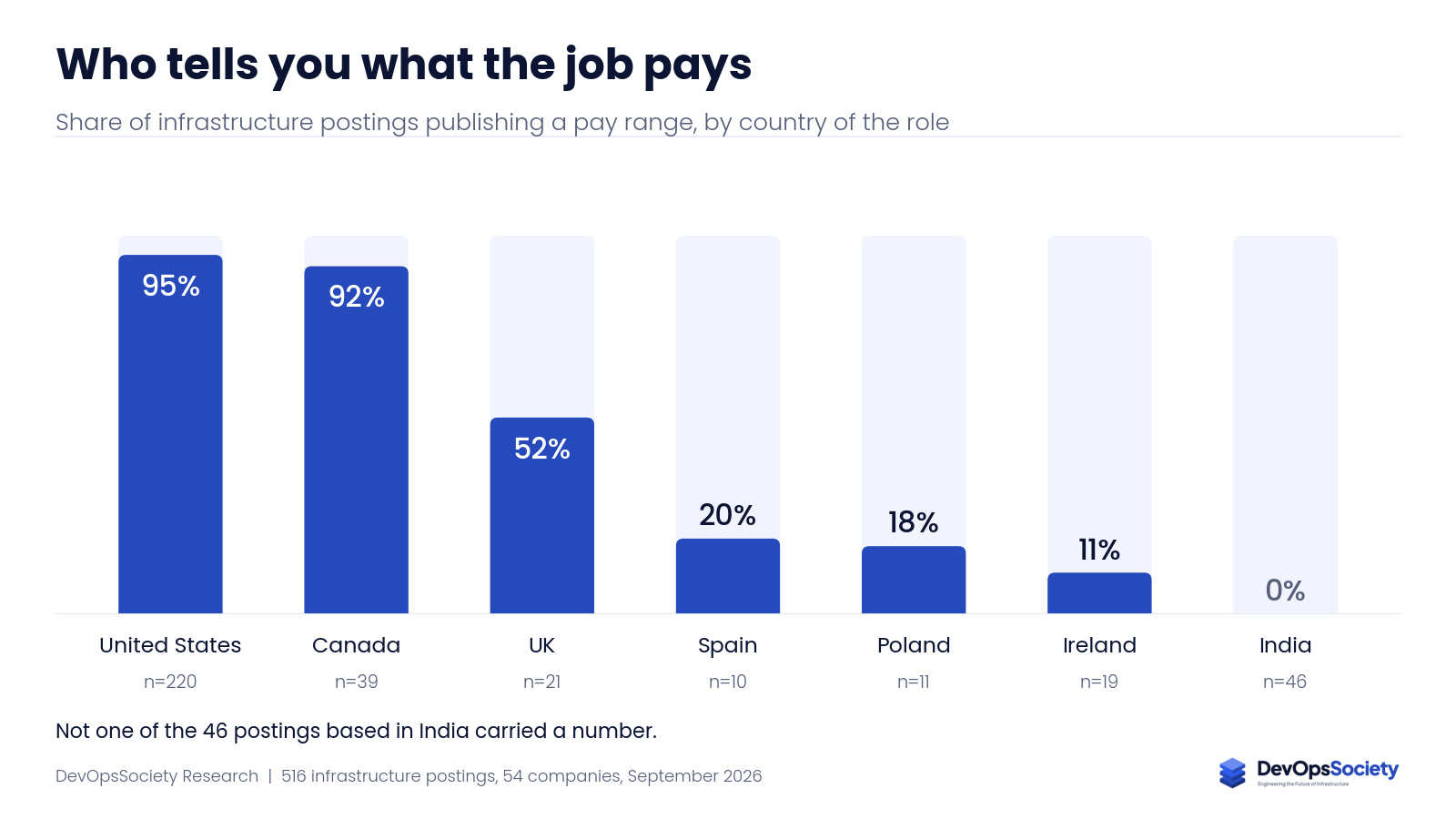
India: zero. Not one of the 46 Indian postings we read published a number.
The easy explanation is law. Several US states require pay ranges, Canada and the EU are moving the same way, and India has nothing comparable on the books. That explanation is correct and it is also incomplete, because it treats companies as if they had no choice in the matter.
Look at what happens inside a single employer:
Company | US postings with a range | India postings with a range |
|---|---|---|
Okta | 16 of 16 | 0 of 10 |
Zscaler | 12 of 12 | 0 of 5 |
Databricks | 10 of 10 | 0 of 6 |
Fivetran | 8 of 8 | 0 of 2 |
GitLab | 4 of 5 | 0 of 5 |
The same recruiting team, the same hiring system, the same job description template. In one country the number is printed. In the other it is withheld. Nothing about the role changed except which law applies.
This matters more than it looks. An engineer in Bangalore applying to Okta cannot see what the company pays for that work anywhere, while an engineer in Austin applying for the adjacent role can. The asymmetry is not between companies, so you cannot shop around it. It is between countries, and it follows you into every negotiation you will ever have with these employers.
If you are hiring in India and you publish a band, you will be close to alone in doing it, which is its own kind of advantage.
The bottom of the ladder is missing
Senior, staff and principal roles account for 308 of the 516 postings. Add engineering managers and directors and you are at 384.
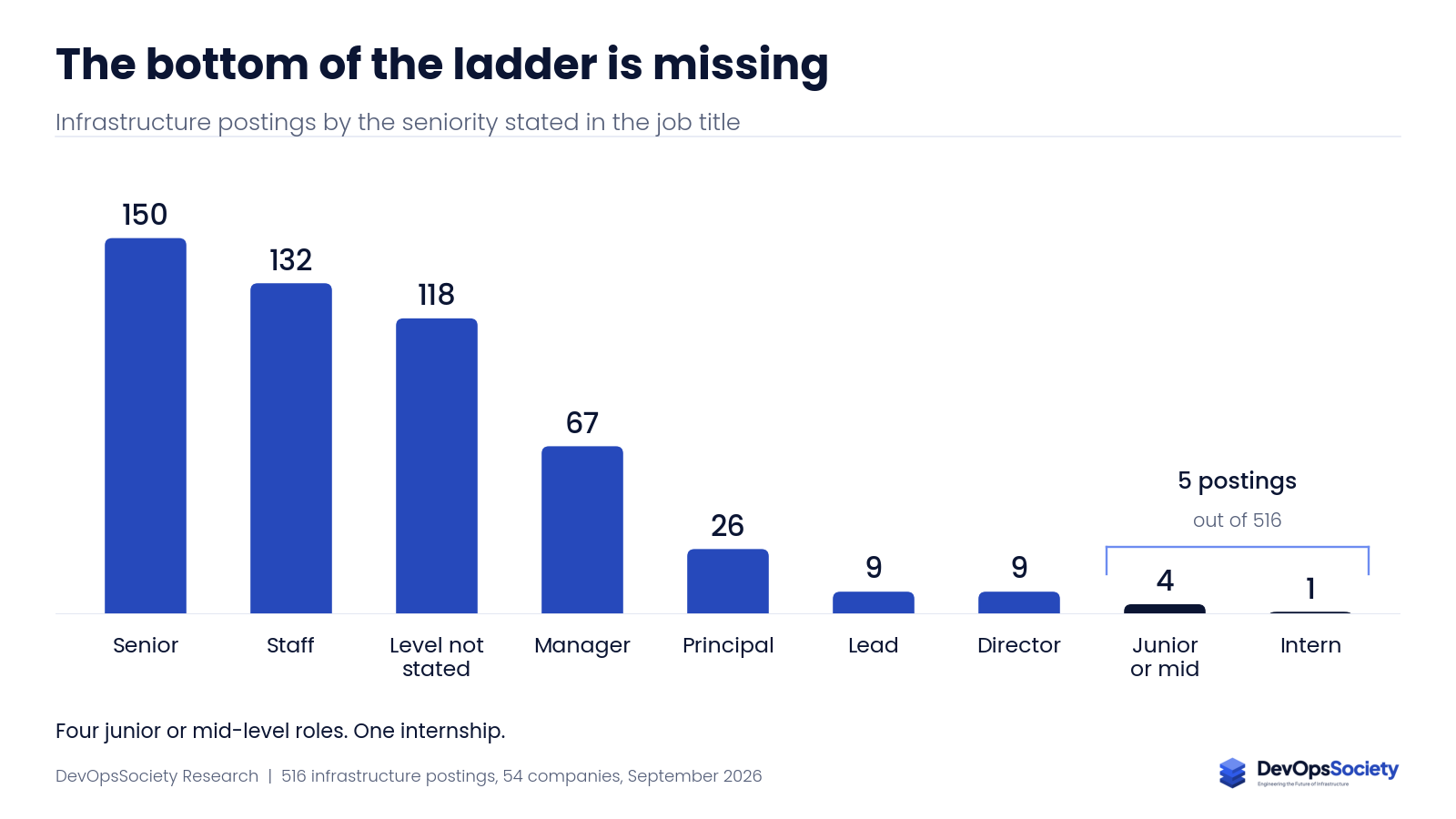
Junior and mid-level roles: four. Internships: one.
Five postings out of 516. Under one percent of a market that these same companies describe, in public, as desperately short of talent.
We want to be careful about what this does and does not prove. Plenty of companies hire juniors through university programmes that never touch the public board, and a title without a level marker is not automatically senior, which is why 118 postings sit in a level not stated bucket rather than being assigned somewhere flattering. Even granting all of that, the shape is hard to argue with. The infrastructure job market at these employers is a market for people who already know how to do the job.
Which raises the obvious question: where is the next generation of SREs supposed to learn? Not on an internal developer platform that was built by the seniors who left. The honest answer from this data is that the industry has outsourced that problem and not decided to whom. If you run a platform team and you have ever complained that senior infrastructure people are impossible to find, look at your own board and count how many people you are training.
Everybody wants on-call. Nobody prices it.
A quarter of the sample, 141 postings, mentions on-call, pager duty or production support as part of the job. That is the honest half, since plenty of the rest will put you in a rotation without saying so.
The number of postings that mention on-call compensation, a stipend, an allowance or any other form of payment for carrying the pager: zero.
Not a low number. Zero, out of 516.
We checked this three ways because we did not believe it. The phrase does not appear. Compensation sections in these postings describe base salary, equity and benefits, and then stop. The pager is treated as a property of the role rather than a thing that costs a person their evenings.
You can argue that it is baked into the band, and for some employers it genuinely is. The problem is that an applicant cannot tell the difference between a job that pays for disruption and a job that expects it for free, because both of them say exactly the same thing on the page. Ask in the interview. Ask what the rotation looks like, how often it fires at night, and whether anything about the compensation reflects it. The silence in 516 job ads is not evidence that the answer is good.
What these jobs actually ask for
Kubernetes appears in 53 percent of postings. AWS is at 47, Python 43, Terraform 34, Google Cloud 34, Go 31, Azure 28.
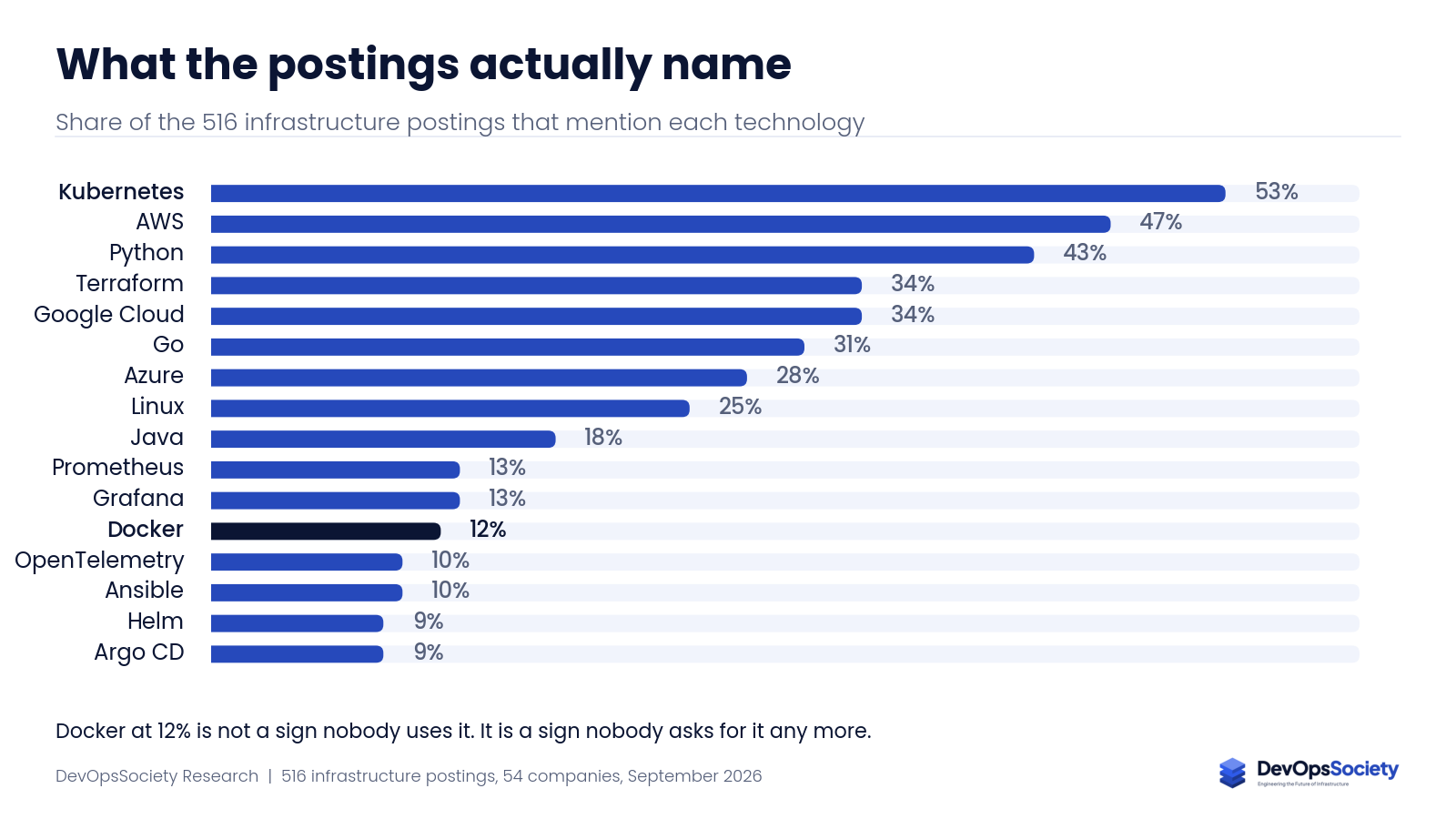
Two things in that list are more interesting than the leader.
The first is Docker at 12 percent. Nobody has stopped using containers. Employers have stopped asking for them, the way nobody puts familiar with SSH in a job ad. When a technology disappears from requirements while its usage keeps climbing, that is the moment it became infrastructure rather than a skill. Kubernetes has not made that transition yet, and the day it does will tell you something.
The second is the configuration management tier. Ansible sits at 10 percent. Puppet and Chef are close to invisible. Helm and Argo CD are at 9 percent each, which is lower than the GitOps discourse would have you believe, and Terraform at 34 percent is now the clear centre of gravity for anyone writing infrastructure as code, with everything that concentration implies for its supply chain.
For anyone deciding what to learn next, the ranking is a reasonable map of what gets you interviews. Kubernetes and one major cloud, then Terraform, then a language, and Go is now a third of the market rather than a niche.
AI is in these jobs, but less than the noise suggests
Forty-two percent of infrastructure postings mention AI in some concrete form. Agentic work and AI agents appear in 20 percent, machine learning or MLOps in 13, LLMs in 11, inference or GPU work in 8, and named assistants such as Copilot or Cursor in 3.
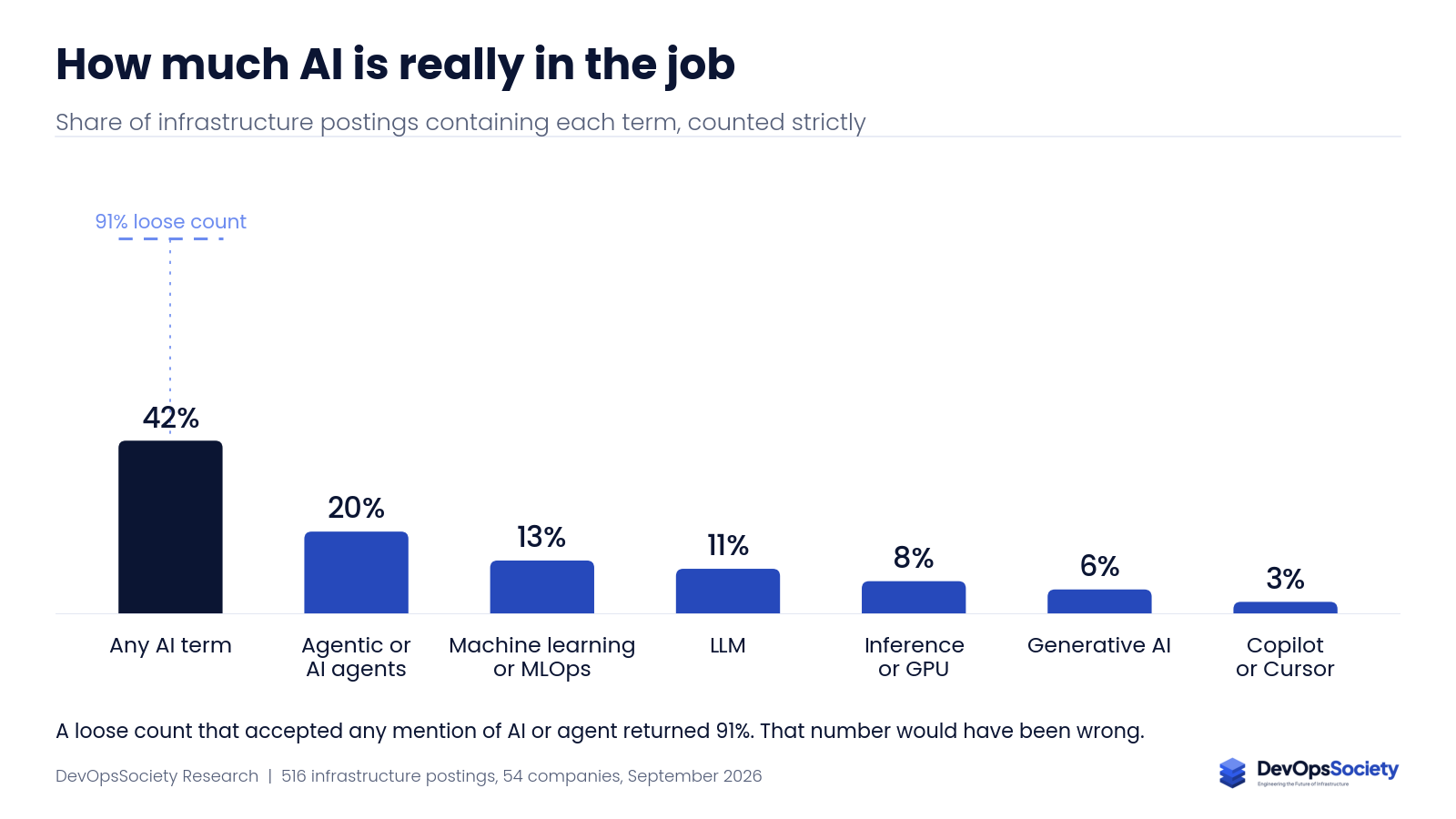
That 42 percent deserves an asterisk, and we are going to give it one, because it is the most likely number in this report to be quoted badly.
Our first count came back at 91 percent. It was wrong. We had counted every stray appearance of the word AI and every use of agent, which sweeps up support agents, user agents and the company boilerplate at the bottom of every posting from a firm that happens to sell AI. Once we narrowed it to terms that only turn up when someone is describing the actual work, the figure fell by more than half.
We are telling you this because the difference between 42 and 91 is the difference between AI is showing up in infrastructure work and AI has taken over infrastructure work, and you will see the second claim made this year by somebody who counted every mention of the word.
Remote, with conditions
Hybrid is now the largest single category at 202 postings, ahead of fully remote at 158. Onsite accounts for 53, and 103 postings do not say.
More useful than the split is what happens inside the remote bucket. Seventy-six of those postings advertise as remote and then attach a geographic qualifier: a country, a region, a list of approved states, or in one memorable case a remote role that excludes the city the company is headquartered in while still quoting that city's pay band.
Remote in this market does not mean location independent. It means you do not come to an office, within a boundary the employer has drawn for tax and legal reasons. If you are planning a move, read the location field before you read anything else.
The requirement people forget to check
One hundred and fourteen postings, 22 percent of the sample, carry a citizenship or clearance requirement. Fifty-five of those are US roles, which is what you would expect from government-adjacent work. The other 59 are not.
That second group is worth pausing on. It includes roles based outside the United States that still require US citizenship or the ability to work in restricted cloud environments, which quietly disqualifies most local applicants before the first call. We found at least one posting for a hybrid role in India carrying a US citizenship clause, which reads like a template that was never cleaned up. Either way, the clause is binding on paper.
Read the fine print in the requirements block. It is the cheapest thirty seconds you will spend on an application.
What the money looks like
Among US postings that publish a range, and using the midpoint of each range:
Level | Postings | Median midpoint |
|---|---|---|
Senior | 49 | 196,000 USD |
Staff | 58 | 255,000 USD |
Engineering manager | 34 | 246,000 USD |
Treat these as a sense of shape rather than a benchmark. Some employers publish base salary only, others publish a total that folds in equity, and a handful of AI labs publish ranges wide enough to swallow both. The widest single band in our data spanned 405,000 to 850,000 USD, which tells you about that company's levelling rather than about the market.
The pattern that does survive scrutiny is the flatness between staff engineer and engineering manager. If you are weighing the management track for money alone, this sample says the money is not the reason.
Conclusions
If you are looking for work: apply to US and Canadian postings knowing the number before you talk, and treat the absence of a number elsewhere as a negotiation you have to start from scratch. Ask about on-call pay explicitly, because no employer in this sample volunteers it. Check the location qualifier on anything described as remote.
If you are hiring: publishing a range outside the US costs you nothing and puts you in a minority small enough to be memorable. Pricing on-call would make you close to unique. And if senior infrastructure hires feel impossible to find, that is partly a market your own board is helping to create.
If you are writing about this market: the strict number is 42 percent, not 91.
We will run this again next quarter. The interesting part will not be the levels. It will be which of these numbers moves. More of our work on how these teams are built and run sits in leadership.
References
The report draws on 516 job postings published by the following 54 companies and live on 25 September 2026: Abnormal Security, Affirm, Airbnb, Airtable, Amplitude, Anthropic, Asana, Brex, Carta, Checkr, Chime, Cloudflare, Cockroach Labs, Coinbase, Cribl, Databricks, Datadog, Discord, Dropbox, Duolingo, Elastic, Figma, Fivetran, Flexport, GitLab, Grafana Labs, Gusto, Harness, Honeycomb, Instacart, JFrog, LaunchDarkly, Lattice, Lyft, Mercury, Mixpanel, MongoDB, Netskope, New Relic, Okta, PagerDuty, Pure Storage, Reddit, Remote, Robinhood, Rubrik, Samsara, Scale AI, Starburst, Stripe, Sumo Logic, Tailscale, Twilio, Vercel and Zscaler.
Citing this report. DevOpsSociety, The Infrastructure Hiring Report: September 2026, published 27 September 2026.
Corrections. If you work at one of these companies and a number here misrepresents your postings, write to us and we will check it against the listing and correct the record in public.
Get the infrastructure briefing.
Practical DevOps, cloud, AI infrastructure and engineering insights, delivered weekly. Read by engineers and engineering leaders.