Security teams have been told for years to patch everything. Microsoft's latest numbers make a strong case that this advice has stopped being useful, and that the real problem is speed on a small set of bugs that matter.
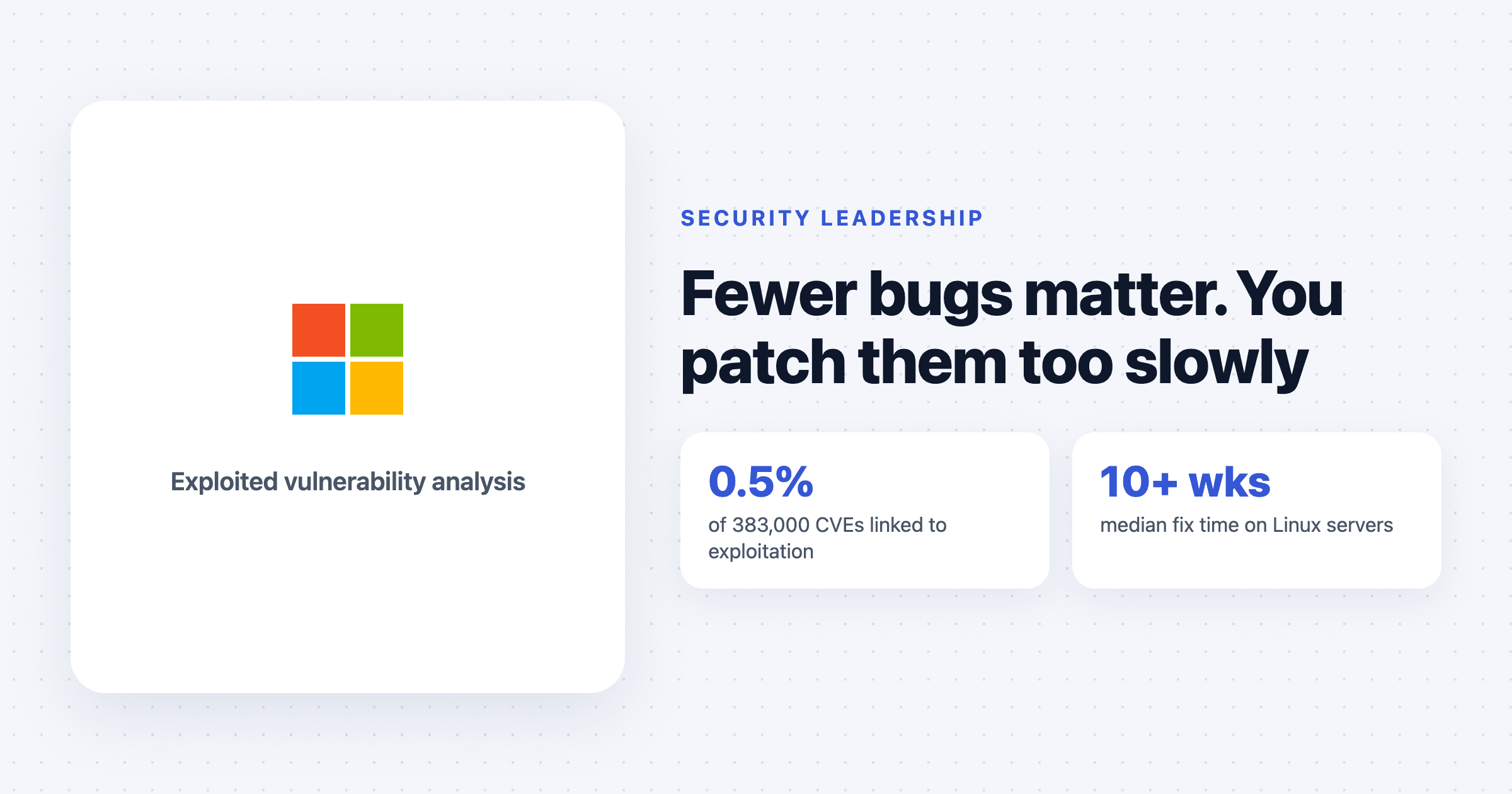
In an analysis published on 2 November, Microsoft looked at about 383,000 published vulnerabilities and found 2,056 linked to real-world exploitation. That is roughly 0.5%, or one in 200.
Which vulnerabilities do attackers actually use?
Exploitation is not spread evenly. It piles up in bugs that let an attacker take control:
Server-side remote code execution makes up 20% of published CVEs but 37% of exploited ones.
Local privilege escalation rises from 11% to 18%.
Client-side remote code execution rises from 4% to 13%.
Operating system flaws rise from 23% of published to 41% of exploited.
Meanwhile denial of service drops from 16% to 7% and cross-site scripting from 15% to 4%. Takeover bugs (remote code execution, authentication bypass and privilege escalation) account for 78% of everything exploited.
How long do teams take to patch?
This is where the report should worry infrastructure leaders. Microsoft's median remediation times by asset type are:
Windows workstations: about two weeks.
Windows servers: more than a month.
Linux servers and macOS applications: more than ten weeks.
Network appliances: more than a year.
Now compare that with attackers. Microsoft cites VulnCheck data showing 29% of 2025 exploits launched within a day of the CVE being published. For 2026 CVEs through September, the median time from publication to the CISA Known Exploited Vulnerabilities list is three days.
So the systems most likely to be hit with a takeover bug, servers and edge devices, are the ones that take longest to fix. The SSHole OpenSSH flaw this week, attacked within nine hours, is a live example.
Why are servers and appliances so slow?
Anyone who has run a fleet knows the reasons. Servers need maintenance windows and someone has to own the reboot. Appliances need vendor firmware, change approval and often a site visit. Linux fleets are frequently split between teams, images and distributions, so nobody has one queue. And because everything is labelled critical by CVSS, the urgent items hide in a list of thousands.
What should engineering leaders change?
Stop using CVSS alone as the queue. Microsoft recommends prioritising by threat, exploitability, internet exposure and how critical the asset is. A takeover bug on an internet-facing server beats a high-scoring bug on an isolated laptop.
Set a separate, short target for takeover bugs on servers. If your policy says 30 days for "critical", you are already losing. Aim for days on exposed servers and appliances when a fix exists and exploitation is reported.
Make servers easier to replace than to patch. Immutable images, automated rebuilds and rolling node replacement turn a ten-week patch into a pipeline run. This is where platform investment pays security back.
Count your appliances. VPNs, firewalls and switches are where the year-long tail lives. If you cannot list them with firmware versions, start there.
Map attack paths. Microsoft suggests finding routes from exposed workloads through privileged identities to critical data and cutting them early. Fewer paths buy time when patching is slow.
The message for leaders is simple. Your backlog is not the risk. Your slowest asset class is.
Quick answers
What share of vulnerabilities are exploited?
Microsoft's 2026 analysis found 2,056 of about 383,000 published CVEs linked to real-world exploitation, roughly 0.5%.
Which vulnerabilities are most often exploited?
Takeover vulnerabilities, meaning remote code execution, authentication bypass and local privilege escalation, make up 78% of exploited vulnerabilities in Microsoft's data.
How long does it take to patch Linux servers?
Microsoft's 2026 data shows a median remediation time of more than ten weeks for Linux servers, compared with about two weeks for Windows workstations and more than a year for network appliances.