Most teams think of an account with no password as the safest kind. If root or a service user on an Alpine box can only log in with an SSH key, there is nothing to guess. A flaw disclosed last week turns that assumption upside down on some systems, and attackers started using it the same day.
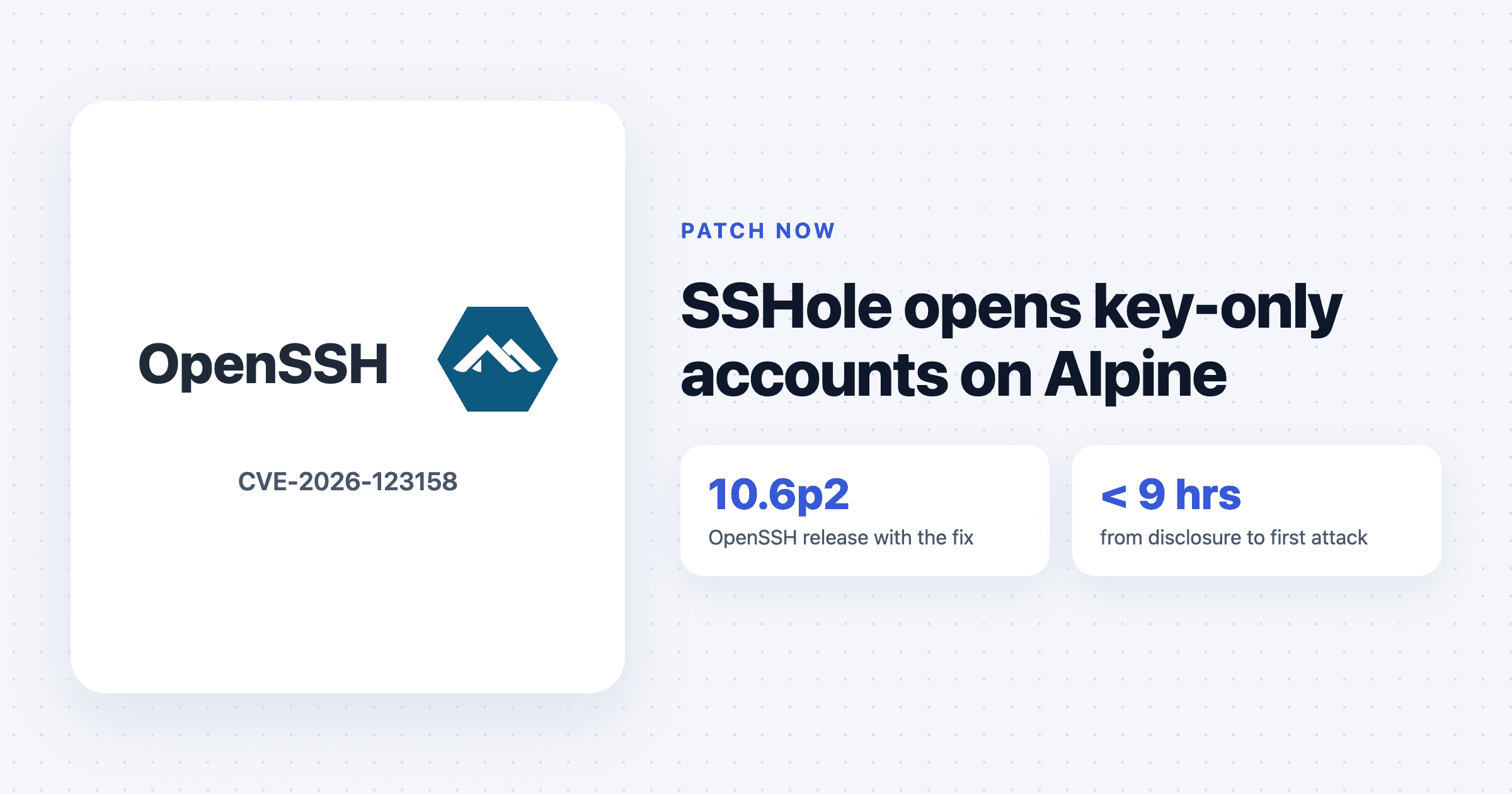
The bug, tracked as CVE-2026-123158 and nicknamed SSHole, affects OpenSSH on Linux systems built on the musl C library when PAM is turned off. That is how Alpine Linux ships its OpenSSH server by default. It carries a CVSS score of 8.1 and was found by Ozgun Kultekin.
How does SSHole work?
The root cause is an old fix. In 2016, OpenSSH changed how it handles password checks to stop attackers from working out which usernames exist (CVE-2016-6210). Under certain conditions on musl, a failed password-hashing call returns a single asterisk. An asterisk is also what the system stores for an account whose password has been disabled. sshd compares the two, sees a match and lets the attacker in.
To trigger it, an unauthenticated attacker sends a password between 257 and 1,024 bytes long. The target has to have at least one account whose stored password hash is "*". Accounts with real password hashes are not affected. Neither are Dropbear, glibc-based distributions such as Debian, Ubuntu and RHEL, non-Linux systems, or setups that check passwords through PAM.
The attacker gets whatever rights that account has. If the account is root, that is everything.
Is it being exploited?
Yes. According to The Hacker News, the security firm Previdian saw the first attempt less than nine hours after the CVE went public and confirmed root access on an Alpine honeypot. The early attacker ran simple reconnaissance commands such as id, uname and hostname. By 8 November attempts had come from 13 different IP addresses in several countries.
Those numbers are small, but the pattern is familiar. Once a bug needs nothing more than a long string, scanning tools add it quickly.
Where are you exposed?
Alpine is everywhere in infrastructure, so the list is longer than it first looks:
Bastion and jump hosts built on Alpine to keep them small.
Containers that run sshd, often for debugging or for legacy tooling that expects SSH. Many teams forget these exist.
CI runners and build agents on Alpine images that accept SSH from an orchestrator.
Appliances and routers that use musl and ship OpenSSH with PAM disabled.
The common thread is an account with a "*" hash that you never thought of as a login risk. On Alpine, root and the default user are the obvious ones.
What should you do now?
Patch. Upgrade to OpenSSH 10.6p2 or your distribution's fixed package, then restart sshd. On Alpine that means
apk upgradeand a restart. Rebuild any container images that bake in openssh-server.Turn off password login where you do not need it. Setting
PasswordAuthentication noin sshd_config means sshd never runs the password check this bug abuses. Most key-only hosts should have this set anyway.Look for signs of use. Alpine's advice is to search
/var/log/messagesfor "Accepted password for" on accounts that should never accept a password, such as root or key-only users. Review doas use, new users, new files and changes to authorized_keys.Assume compromise if you cannot rule it out. If an internet-facing host had password login on and you find a suspicious entry, rebuild it rather than clean it.
Find the SSH you forgot. Scan your container images for openssh-server. A debugging shell left in a production image is now a known way in.
The bigger lesson
SSHole is a reminder that "disabled" is a state the software has to interpret, not a guarantee. A blank or locked password is only safe if every code path that reads it agrees on what it means. Here, a ten-year-old fix and a different C library disagreed.
It also makes a case for fewer ways in. Hosts that only accept keys should not run password authentication at all, and containers should not run sshd unless there is a reason that someone has written down.
Quick answers
What is SSHole?
SSHole is the nickname for CVE-2026-123158, an OpenSSH flaw on musl-based Linux systems with PAM disabled, including Alpine's default setup. It lets an attacker log in to accounts whose password is disabled by sending a password of 257 to 1,024 bytes.
Which OpenSSH version fixes SSHole?
OpenSSH 10.6p2 fixes it, along with patched packages from distributions such as Alpine. Restart sshd after updating.
Are Ubuntu and Debian servers affected by SSHole?
No. Systems built on glibc, including Debian, Ubuntu and RHEL, are not affected, and neither are setups that check passwords through PAM or servers running Dropbear.