Someone forwarded you the monthly bill with a one-line message: "this is up 30%, can you look at it?" You open Cost Explorer, see a bar chart that says EC2 is expensive, and learn nothing you didn't already suspect. A week later you're in a meeting where a finance analyst asks why the "other" line item grew, and nobody in the room can answer, because nobody in the room knows which service that line item belongs to.
That meeting is the reason FinOps exists. The uncomfortable part is that it is mostly your problem, not finance's. Cloud financial management is the practice of connecting spend back to the engineering decisions that caused it, and almost every one of those decisions was made by someone with commit access. This guide covers the framework, the parts of it worth your time, the parts you should ignore in year one, and the specific ways FinOps programmes fail.
Cloud financial management is an engineering problem wearing a finance costume
A cloud bill is not an expense report. It's a telemetry stream describing your architecture, emitted hourly, denominated in dollars. Retention policy shows up as S3 cost. A chatty service placed in the wrong availability zone shows up as data transfer. An autoscaling group with a floor set during a launch two years ago shows up as idle compute. A debug log level left on in production shows up in CloudWatch ingestion and then again in whatever you ship logs to.
Finance can't fix any of that. They can forecast it, allocate it, and challenge it, but the remediation is a pull request. This is the single idea that separates FinOps practices that work from the ones that produce quarterly slides: the cost data has to reach the person who can change the code, in a form specific enough to act on, before the invoice closes.
What finance genuinely owns is the money side the forecast, the contract, the budget envelope, the commitment portfolio. What engineering owns is everything that determines the number inside that envelope. The friction in most organisations comes from the middle, where a cost has been identified but nobody agrees whose sprint it lands in.
The FinOps Foundation framework, and how much of it to take seriously
The FinOps Foundation publishes the canonical framework, and it's genuinely useful as shared vocabulary. It's organised into four domains Understand Usage & Cost, Quantify Business Value, Optimize Usage & Cost, and Manage the FinOps Practice each containing capabilities like Allocation, Forecasting, Unit Economics, Rate Optimization and Anomaly Management. Underneath sits a Crawl/Walk/Run maturity model.
The part everyone quotes is the three phases.
Inform is visibility and allocation: getting cost and usage data ingested, attributed to something meaningful, and in front of people. Optimize is finding the efficiency opportunities the data exposes, split between rate and usage. Operate is making the changes stick continuous improvement, with engineering, finance and product actually cooperating.
Read the phases as a loop, not a ladder. The common misreading is treating them as a three-stage project plan, which produces a six-month Inform phase that ends in a dashboard and no changed behaviour. In practice you run all three simultaneously at different maturity for different workloads: your Kubernetes estate might be in Operate while the data platform is still uninstrumented.
The framework is also deliberately organisation-shaped: a lot about personas, executive alignment and practice operations, comparatively little about how to actually reduce a bill. That's fine for a framework, but don't mistake reading it for doing the work.
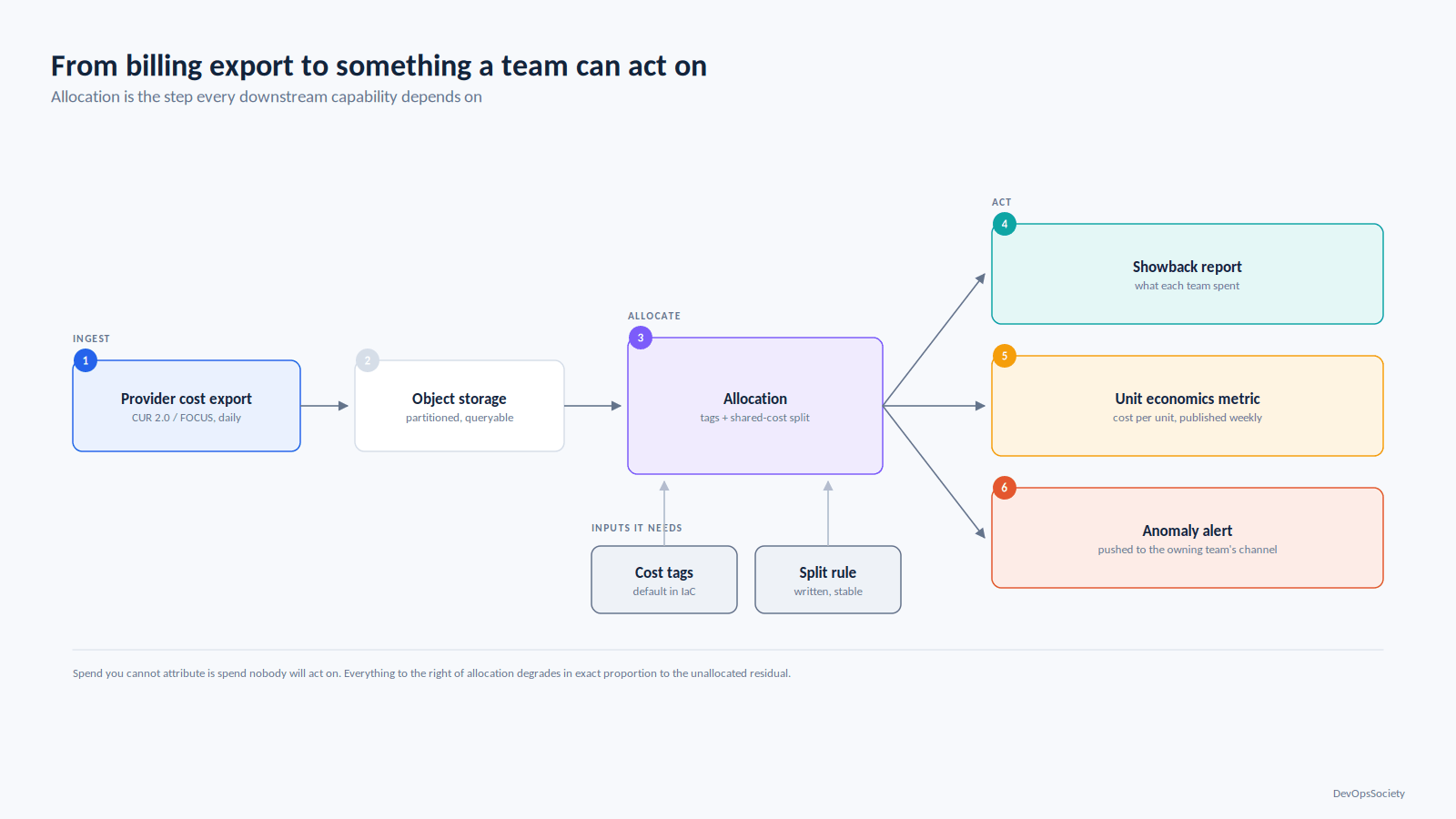
Allocation first, because nothing else works without it
You cannot optimise what you cannot attribute. Every FinOps capability downstream of allocation showback, unit economics, anomaly routing, forecasting degrades in exact proportion to how much of your spend is unattributable.
The number to watch is the unallocated residual: the percentage of spend you cannot tie to a team, service or product. Most organisations starting out discover somewhere between a quarter and half of spend sitting in that bucket. That residual is where the argument lives. Present a team with a cost report and the first thing they'll do is dispute the parts they don't recognise, and if 40% of the bill is "shared", they're right to.
Tag at the infrastructure-as-code layer, enforce in CI
Tagging campaigns fail. Tagging defaults work. The difference is where you put the control: a spreadsheet of resources to go back and label is a project that never finishes, whereas a provider-level default plus a CI gate is a property of the system.
# provider.tf — every taggable resource inherits these without the module author thinking about it
provider "aws" {
  region = var.region

  default_tags {
    tags = {
      owner       = var.team_slug     # must match an IdP group, never an individual's name
      cost_center = var.cost_center
      service     = var.service_name
      env         = var.environment
    }
  }
}
Then reject plans that produce untagged resources, in the same pipeline stage where your other policy checks run:
# policy/tags.rego — run with conftest against `terraform show -json tfplan`
package terraform.tags

required := {"owner", "cost_center", "service", "env"}

deny contains msg if {
  r := input.resource_changes[_]
  r.change.actions[_] != "delete"
  missing := required - object.keys(object.get(r.change.after, "tags", {}))
  count(missing) > 0
  msg := sprintf("%s missing cost tags: %v", [r.address, missing])
}
This is the same control pattern as gating pipelines on security policy rather than reviewing findings after deploy, and it belongs in the same stage. If your organisation has a platform team, cost tags should be baked into the service template so nobody chooses them by hand. Golden paths are the cheapest allocation mechanism available, and treating the platform as a product with defaults rather than a ticket queue is what makes the defaults hold.
Two AWS-specific gotchas worth knowing. Tags do nothing for billing until you activate them as cost allocation tags in the billing console resources can be perfectly tagged and still show as unallocated. And since 2024, activating a tag supports retroactive application, so you can backfill up to twelve months of billing data rather than starting your history from today.
The costs that will never carry a tag
NAT gateways, transit gateways, load balancers fronting many services, Kubernetes control planes, shared observability pipelines, support charges, cross-AZ traffic between tenants of the same cluster. These are real and they are not going away.
Pick a split rule, write it down, and defend it. Proportional-to-compute is the usual default and is good enough. What matters is that the rule is published and stable, because the actual failure mode isn't an imperfect split it's teams relitigating the split every month instead of fixing anything. For containerised estates, an in-cluster cost allocation tool (OpenCost and its commercial descendants) is worth the effort once more than a couple of teams share a cluster, because the billing export sees nodes and you need pods.
If you run more than one cloud, look at FOCUS, the FinOps Foundation's open billing specification. The major providers now publish FOCUS-conformant exports, which removes a genuinely tedious normalisation layer. If you run one cloud, skip it for now.
Showback before chargeback
Showback tells a team what they spent. Chargeback moves money from their budget. The mechanics are similar; the politics are not.
Start with showback and stay there longer than you think you need to. Chargeback only works when allocation accuracy is high enough to survive a hostile reading, because the moment real budget moves, every engineer becomes a forensic accountant. A team that gets billed for an unallocated residual they didn't cause will spend the quarter arguing about the model, and that argument is pure overhead.
The signal that you're ready for chargeback is that nobody disputes the showback numbers anymore. If that day hasn't arrived, chargeback will not create the accountability you're hoping for; it will create a queue of disputes.
Unit economics is the only metric that survives growth
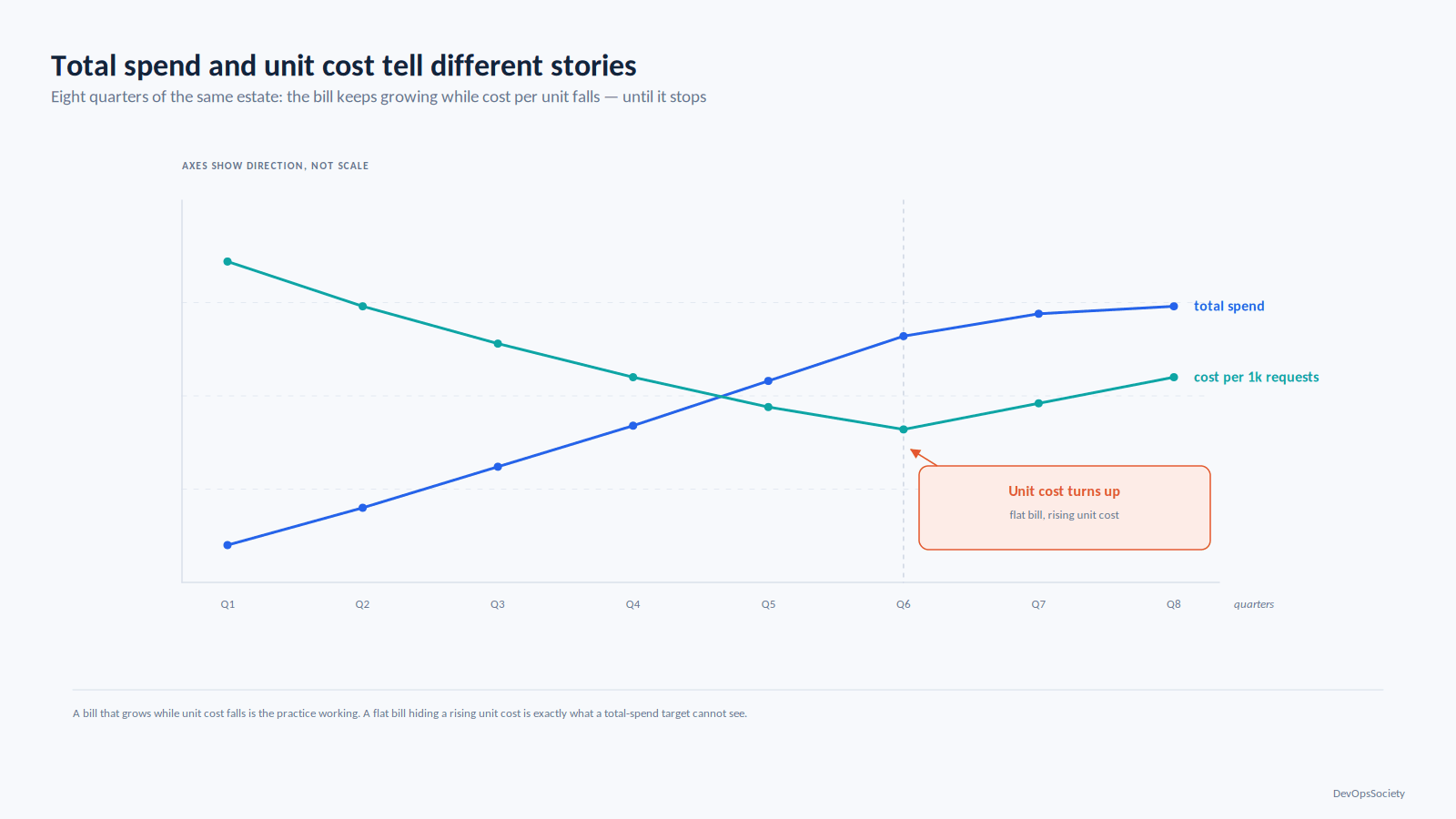
Total spend is a bad target. A company growing 60% a year will grow its cloud bill, and a FinOps practice whose headline metric is "bill went down" is structurally opposed to the business succeeding. That practice gets ignored, correctly.
The metric that survives is cost per unit of something the business recognises: cost per thousand API calls, per active tenant, per order processed, per model inference, per gigabyte indexed. Now the story is legible. Spend up 40%, unit cost down 15%, means you got more efficient while growing. Spend flat and unit cost up means you have a problem that a flat bill was hiding.
Choose the denominator carefully. It has to be something engineering can influence: "cost per dollar of revenue" is a fine board metric and a useless engineering one, because the sales team moves it. Be honest that some spend is fixed too control planes and baseline observability don't scale down with traffic, so early unit costs look terrible and improve on their own.
-- Cost per owning team per day, with the unallocated residual made impossible to hide.
-- CUR 2.0 exposes tags as a map; keys carry the user_ prefix once activated for billing.
SELECT
  date(line_item_usage_start_date) AS usage_day,
  coalesce(nullif(resource_tags['user_owner'], ''), 'UNALLOCATED') AS team,
  sum(line_item_unblended_cost) AS cost
FROM cur2.daily
WHERE bill_billing_period_start_date = date '2026-09-01'
  -- amortised view: count what the commitment covered, not the upfront fee
  AND line_item_line_item_type IN ('Usage', 'DiscountedUsage', 'SavingsPlanCoveredUsage')
GROUP BY 1, 2
ORDER BY usage_day, cost DESC;
Divide that by a usage counter you already emit, publish it weekly, and you have a metric that will still be meaningful in two years.
Rate optimization versus usage optimization
Both reduce the bill. They are not equally important, and the industry spends disproportionate attention on the wrong one.
Rate: commitments, and how to not get trapped by them
Rate optimization means paying less for the same consumption. The instruments differ by provider but rhyme. AWS offers Reserved Instances and Savings Plans Compute Savings Plans apply across EC2, Fargate and Lambda regardless of instance family or region, EC2 Instance Savings Plans trade that flexibility for a deeper discount, and there are service-specific variants. Azure has reservations plus a savings plan for compute. Google Cloud has resource-based committed use discounts, tied to a region and machine shape, and flexible spend-based CUDs that cover Compute Engine, GKE and Cloud Run against an hourly spend commitment.
The shape is consistent: one-year or three-year terms, deeper discounts for longer terms and more upfront payment, and less flexibility the deeper you go. Savings Plans express the commitment as a dollar amount of compute per hour rather than as specific instances, which is why they survive instance-family changes. Get actual numbers from the provider's own calculator and pricing pages rather than any blog, including this one rates move.
Rate optimization has a hard ceiling. You can only discount consumption you're already committed to running, and once coverage is high there's nothing left. It also carries the most spectacular failure mode in FinOps: the three-year commitment bought six weeks before an architecture change. A team buys deep coverage on x86 general-purpose instances, then finishes the Graviton migration or consolidates four clusters into one. The savings evaporate and the commitment doesn't. Savings Plans can't be cancelled or resold; standard RIs have a marketplace, convertible RIs can be exchanged, and neither gets you out cleanly.
Three rules that prevent most of this. Commit to your floor, not your average target coverage meaningfully below 100% of steady-state usage so normal variance doesn't leave you stranded. Ladder purchases in small tranches across the year rather than one annual buy, so expiries stagger and you re-underwrite regularly. And make commitment purchases contingent on an architecture review, because the roadmap is the input that matters most and it never appears in the billing data.
Usage: where the money actually is
Usage optimization means consuming less. This is where the durable savings live, because it compounds with the discount rather than competing with it, and because it's bounded only by how wasteful you currently are.
The usual suspects, roughly in order of how often they pay off: idle and orphaned resources (unattached volumes, dev environments running at 3am, load balancers with no targets); oversized instances and containers with requests set from a copied manifest; storage lifecycle and retention, particularly log and snapshot retention that nobody ever revisited; cross-AZ and egress traffic caused by placement rather than necessity; observability ingestion, which quietly becomes a top-five line item; and workload scheduling, especially anything batch that could run on Spot or preemptible capacity.
GPU estates deserve separate treatment. Utilisation on accelerator fleets is routinely dreadful, and the fix is scheduling and queueing rather than rate negotiation the economics of building and operating AI infrastructure are dominated by keeping expensive silicon busy, not by the hourly rate you pay for it.
Lever | Effort | Typical payback | Who owns the decision |
|---|---|---|---|
Delete idle and orphaned resources | Low | Days | Owning team, automated sweep |
Storage lifecycle and log retention | Low | Weeks | Owning team + security (retention floors) |
Non-prod scheduling (off out of hours) | Low | Days | Platform team, applied by default |
Rightsizing instances and pod requests | Medium | Weeks | Owning team, from profiling data |
Commitment purchases | Medium | Immediate, locked in | Central FinOps + finance, engineering sign-off |
Spot / preemptible for batch | Medium | Weeks | Owning team + platform |
Data transfer and AZ placement | High | Months | Architects + owning team |
Re-architecture (managed services, serverless) | High | Quarters | Engineering leadership |
Note the asymmetry: the cheap levers are owned by teams and the expensive ones are owned by architects. A FinOps practice that only ever produces rightsizing tickets has capped its own ceiling.
Anomaly detection, or how to avoid the dashboard nobody opens
Budgets are lagging indicators. By the time a monthly budget alert fires you've spent the money. Anomaly detection is the part of FinOps that behaves like monitoring, and it should be built like monitoring.
AWS Cost Anomaly Detection runs ML-based monitors roughly three times a day, accounts for weekly and monthly seasonality, and ranks root cause across service, account, region and usage type. It needs about ten days of history on a new subscription and inherits up to 24 hours of Cost Explorer data latency, so treat it as next-day detection rather than real time. Azure and Google Cloud have equivalents.
resource "aws_ce_anomaly_monitor" "per_service" {
  name              = "service-level-anomalies"
  monitor_type      = "DIMENSIONAL"
  monitor_dimension = "SERVICE"
}

resource "aws_ce_anomaly_subscription" "platform" {
  name             = "platform-anomalies"
  frequency        = "IMMEDIATE"   # daily digests get filtered to a folder and die there
  monitor_arn_list = [aws_ce_anomaly_monitor.per_service.arn]

  subscriber {
    type    = "SNS"
    address = aws_sns_topic.finops_alerts.arn  # fan out to the owning team's channel, not a shared inbox
  }

  # Absolute-impact floor stops the pager firing on a rounding error in a sandbox account
  threshold_expression {
    dimension {
      key           = "ANOMALY_TOTAL_IMPACT_ABSOLUTE"
      match_options = ["GREATER_THAN_OR_EQUAL"]
      values        = ["250"]
    }
  }
}
The failure mode here is the same one that kills every observability project: you build a pull-based dashboard and assume people will visit it. They won't. Nobody opens a cost dashboard voluntarily, ever. Push the signal into the channel where the owning team already works, make it specific enough to act on, and set the threshold high enough that the alert still means something in month six. An anomaly alert that fires weekly and is dismissed weekly is worse than no alert, because it trains people to ignore the category.
Who actually owns a cost decision
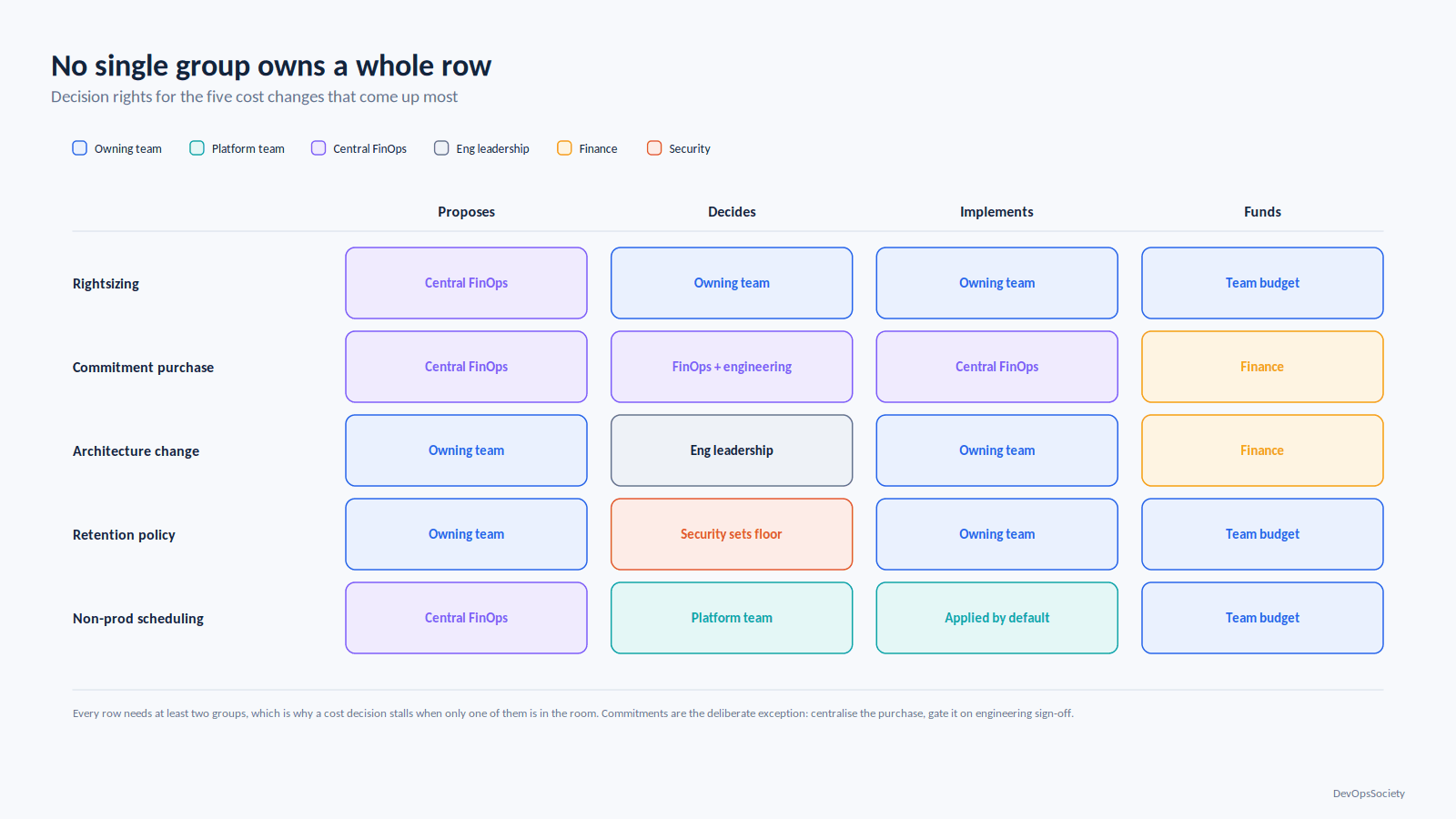
The default answer, and the right one for most decisions: the team that can merge the change owns it. Central FinOps owns the data quality, the allocation model, the tooling and the commitment portfolio. Finance owns the forecast and the contract. Nobody else gets to make an engineering trade-off on a team's behalf.
Commitments are the deliberate exception. They're portfolio risk, they need aggregation across the whole estate to be sized correctly, and an individual team buying a three-year commitment on its own usage is a bad idea. Centralise the purchase, but gate it on engineering sign-off about the roadmap.
Then there's the failure mode nobody puts on a slide: cost reduction that quietly degrades reliability. Somebody drops a database to a single AZ, or cuts replica count to the minimum that handles median load, or shortens log retention below the window you need to investigate an incident, or removes the headroom that absorbed your last traffic spike. Each saves money. Each is invisible until the outage.
The guardrail is procedural and cheap: cost-motivated changes go through exactly the same review as any other production change, and your SLOs are the floor, not a negotiating position. If a proposed saving requires relaxing an availability target, that's an SLO conversation with the service owner, not a FinOps ticket. Write that rule down before the cost-cutting drive starts, not during it.
What to do in the first year
Start here, in this order:
Get allocation above 90%. Provider default tags, a CI gate, backfilled cost allocation tags, a written and published shared-cost split rule. Nothing else matters until this is done.
Pick one unit metric and publish it weekly. One. Not a scorecard.
Ship anomaly alerts into team channels with a threshold you'd actually respond to.
Sweep idle and orphaned resources on a schedule, and schedule non-prod environments off by default. This is the fastest money in FinOps and it needs no meetings.
Buy a conservative first commitment tranche covering your obvious floor, after someone has checked the roadmap.
Ignore, for now: chargeback, building a custom cost platform, multi-cloud normalisation if you're effectively single-cloud, sustainability reporting, renegotiating your enterprise agreement, and any target that includes the number 100%. Also ignore the instinct to hire a FinOps specialist before the data is trustworthy they'll spend their first two quarters doing the allocation work you skipped.
The honest test of whether your practice is working isn't the size of the bill. It's whether an engineer, mid-design-review, can say "that'll roughly double our egress" and have everyone in the room take it as seriously as a latency number. More background on the specific levers lives in our FinOps coverage; the organisational half of the problem is harder than any of it, and it's the half that determines whether the engineering half gets done.