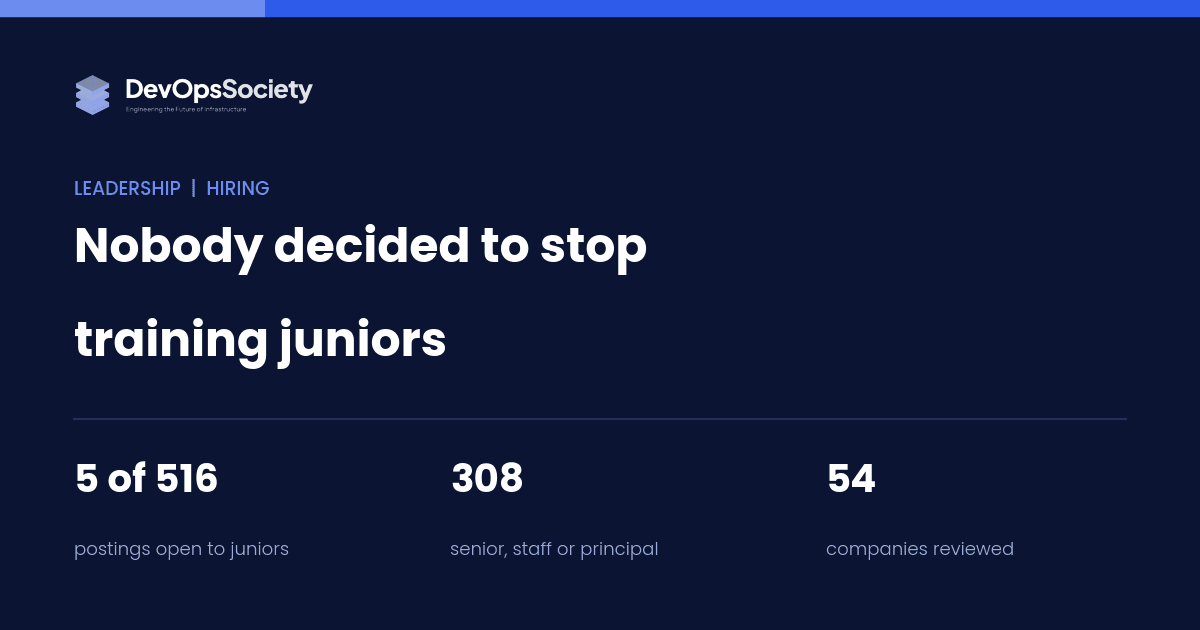
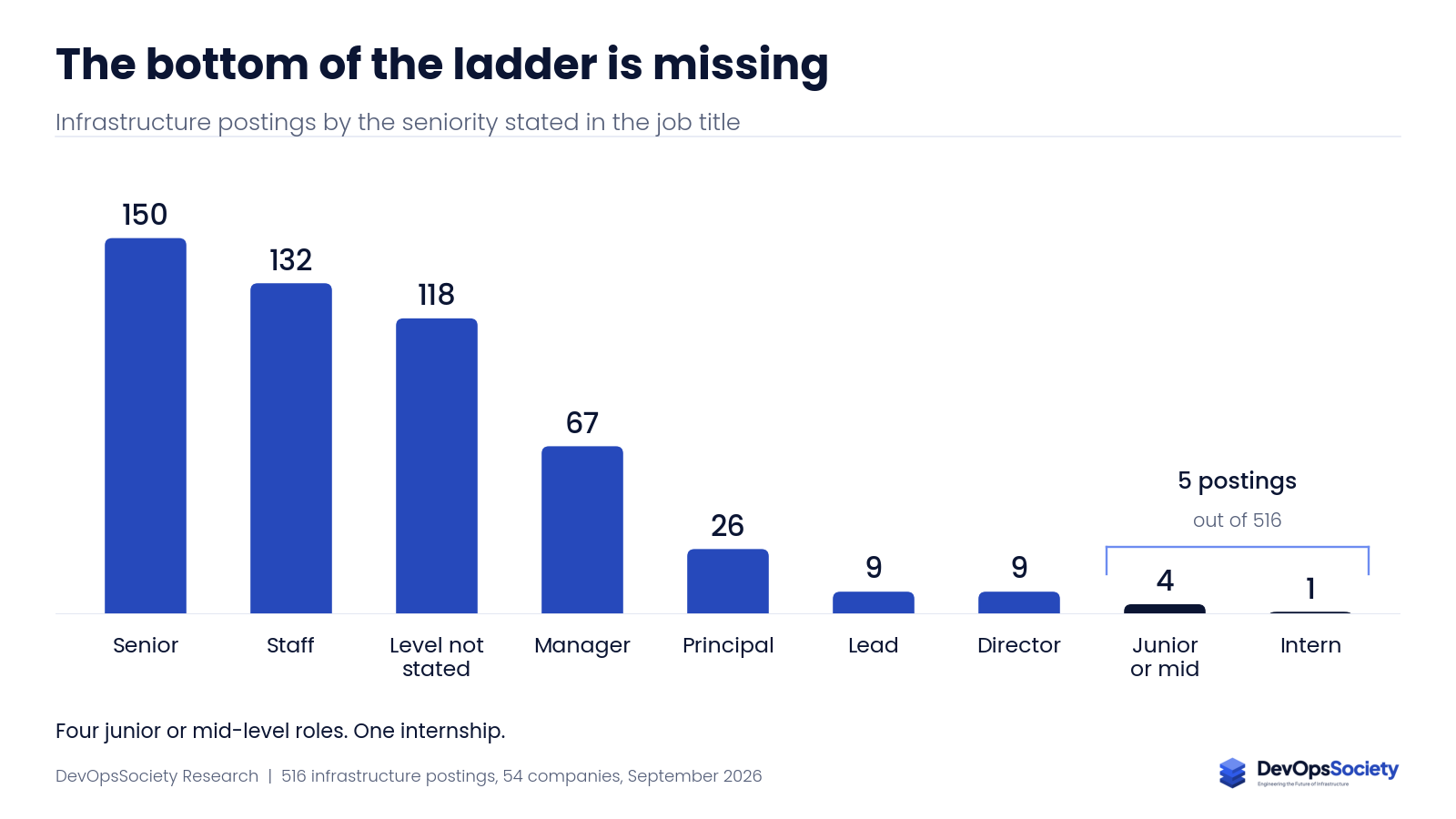
We read 516 infrastructure job postings last week, from 54 companies, on the day they were live. Four of them were open to junior or mid-level engineers. One was an internship. That is five, out of five hundred and sixteen, from companies that will tell you in the same breath that senior infrastructure talent is impossible to find.
No one at any of those companies decided to stop training people. That is what makes this worth an hour of your attention. Every individual decision behind that number was reasonable, and the sum of them is a market with no front door.
What the postings actually say
Senior, staff and principal titles account for 308 of the 516. Add engineering managers and directors and you are at 384. A further 118 carry no level marker at all, which we counted as level not stated rather than quietly assigning them somewhere flattering.
You can argue with the edges of that. Plenty of companies hire graduates through university programmes that never touch the public job board, and a title without a level is not automatically senior. Grant both objections in full and the shape does not move. The roles these companies advertise to the open market are, almost without exception, for people who already know how to do the job.
The hiring market for infrastructure engineers is a market for people somebody else trained.
Why every one of those decisions was rational
Put yourself in the hiring manager's chair, which you probably occupy already.
You have one open headcount. Your on-call rotation is thin, and the last incident ran past midnight because only two people understood the failure. You have a migration due this quarter. A senior hire is productive in six weeks. A junior hire is productive in six months, and in the meantime consumes roughly a day a week of the same senior engineer whose time you were trying to protect.
Nobody in that position chooses the junior. The choice is correct at the level of the team and the quarter. It is only wrong at the level of the industry and the decade, and no individual manager is paid to optimise at that level.
That is the actual mechanism. It is not indifference and it is not cost cutting. It is a thousand locally correct decisions with a cost that lands on somebody else, later.
The bill arrives as a hiring problem
Three things follow, and you are probably already paying for at least one.
Senior supply stops growing. The pool of people who can run production infrastructure is fed by people who learned it on the job, because nothing else teaches it. Fewer entry positions today means a smaller senior pool in three to five years, and the companies competing hardest for that pool are the ones that stopped hiring into the bottom of it.
Your seniors get more expensive and harder to keep. Scarcity does what scarcity does. The postings we read confirm it at the top end: US median range midpoints landed around 196,000 USD for senior and 255,000 USD for staff. You are competing for a shrinking group against companies with deeper pockets.
Knowledge stops moving. A team of only seniors does not document, because everyone already knows. The system you cannot onboard anyone into in under six months is the same system that pages one specific person every time it breaks. Juniors are, among other things, a continuous test of whether your platform is comprehensible.
There is a fourth cost that is harder to see. Senior engineers who never teach anyone stop growing themselves, and a meaningful number of them leave for somewhere they can.
What the alternatives really cost
Most teams facing the gap reach for one of three things. It is worth being honest about what each one buys.
Approach | What it actually costs | When it works |
|---|---|---|
Hire seniors only | Highest salary cost, thinnest bench, every departure is a crisis | Short runway, or a genuine specialist need |
Contractors and agencies | Capacity without retention. The knowledge leaves when the contract ends | Burst work with a clear end date |
Train juniors | Six to twelve months before net positive, plus a real load on your seniors | You expect the team to exist in two years |
The third row is the only one that makes the problem smaller over time. It is also the only one that requires you to commit to something beyond the current quarter, which is precisely why it loses.
If you are going to do it, do it properly
Half-hearted junior hiring is worse than none. The pattern that fails is familiar: a junior joins, gets handed tickets nobody else wants, is never given ownership of anything, and leaves in fourteen months having learned how to close tickets.
What works is duller than that.
Pick a ratio and hold it. One in four or one in five hires. Written down, so it survives the quarter where the migration is late and the senior candidate is available.
Give them a surface, not a queue. Something small and real that they own end to end: the runbook set, the dashboards, the staging environment, the cost report. Ownership teaches judgement. Tickets teach ticket closing.
Put them in the rotation early, shadowed. On-call is where infrastructure engineers are actually made. Shadow first, then secondary, then primary with someone reachable. If your production environment is too dangerous for a supervised junior, you have learned something important about your production environment.
Make mentoring count in levelling. If your staff engineer's promotion case has no room for the two people they grew, you have told them exactly how much it matters. Nobody teaches for free twice.
Commit for two years or do not start. A junior becomes net positive somewhere between month six and month twelve. If you cannot see your team surviving that long, hire the senior and be honest about it.
What this means for the platform you run
There is a second reading of the same data, and it is the one worth taking to your next planning session. If your infrastructure cannot be operated safely by a competent engineer in their first year, that is a property of the infrastructure, not the engineer.
Every serious platform engineering effort is, underneath the tooling, an argument that the operating surface should be small enough to hand to someone new. Golden paths, paved roads and internal platforms all exist to make the second engineer as productive as the first. A team that cannot onboard a junior in six months has a platform problem wearing a hiring problem's clothes.
That is the test I would apply. Not "should we hire juniors" in the abstract, but: how long would it take a good engineer with one year of experience to safely deploy a change here? If the honest answer is nine months, the number to fix is not your headcount.
What to do this week
Open your own careers page and count. How many of your open infrastructure roles are open to someone with less than five years of experience? If the answer is zero, that was a decision, whether or not anyone made it deliberately.
Then ask your team leads one question: who are you training right now, and what will they own in six months? The teams that have an answer are building the senior engineers you will otherwise be trying to hire from them in 2029.
The full dataset, method and charts are in the Infrastructure Hiring Report, and more of our work on how infrastructure teams are built and run sits in leadership.