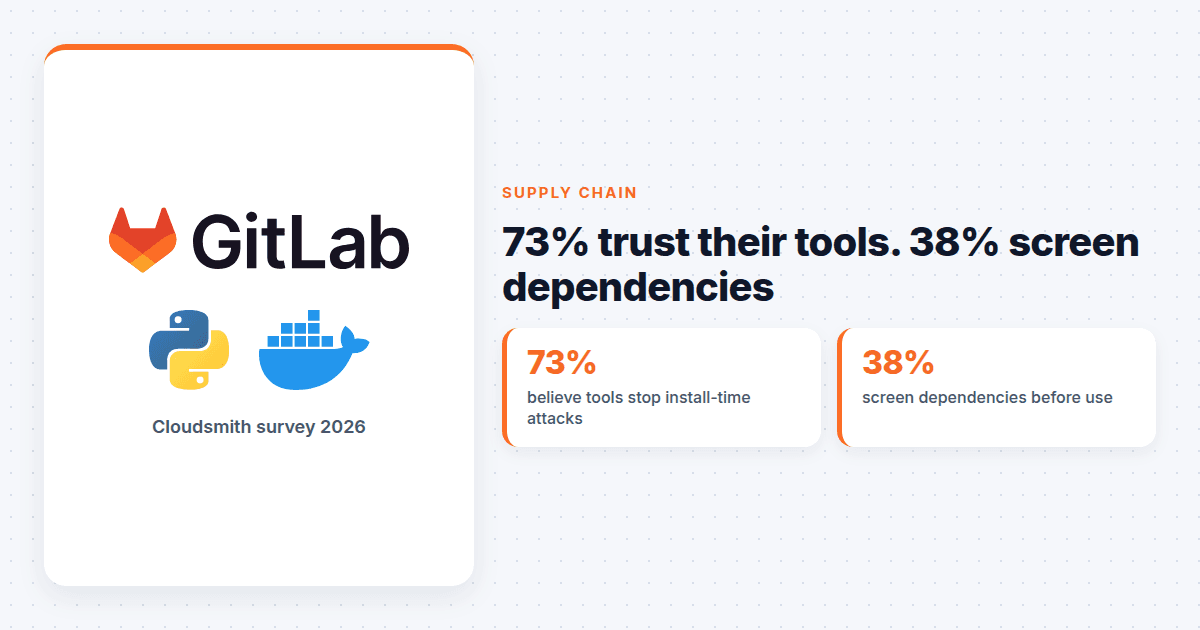
Most engineers trust their software supply chain security more than their habits justify. A Cloudsmith survey of 400 platform and security engineers in the US and UK, published at the end of September, found that 73% believe their tools can stop an install-time attack before a security advisory is even issued. Only 38% actually screen dependencies before they enter their systems.
October tested that confidence twice. On 21 October a poisoned LiteLLM release reached PyPI and Docker Hub, and the same day GitLab patched a second CVSS 10.0 flaw in self-managed GitLab in nine days. If you run engineering, asking your team whether you are secure will get you a shrug. Asking the five specific questions below will get you a plan.
What did the Cloudsmith survey find?
The gap between 73% and 38% is the headline. The detail, reported by SecurityBrief, is where the work is. Just 24% automatically enforce a cooldown period on newly released dependencies. 54% act only after malicious code is already inside their systems, and another 8% have no consistent response at all.
Provenance is used, but rarely trusted on its own. Half the respondents treat provenance or attestation data as one trust signal, and only 8% call it their main one.
On who should decide whether to trust an open source dependency, 39% said a central security, platform or governance team, and 37% said it should be shared with developers.
What happened with LiteLLM?
According to the LiteLLM incident post, version 1.107.0 was live on PyPI from 11:39 to about 13:23 UTC on 21 October. On Docker Hub, the v1.107.0, latest, main-latest and main-stable tags pointed to a compromised image from 11:46 to 14:20 UTC. The payload stole credentials and set up a remote code loader.
The attacker got hold of GitHub CLI OAuth tokens, used them to override branch protections and pointed the release workflow at a lookalike repository. LiteLLM told users to treat any affected environment as compromised, pin to 1.106.2, rebuild from scratch and rotate every secret the host could reach.
LiteLLM is an AI gateway. It holds model provider keys by design. That makes it exactly the kind of package an attacker wants.
And GitLab?
On 21 October GitLab fixed CVE-2026-110264, rated CVSS 10.0, which could let an unauthenticated user run code on a self-managed server through a crafted regular expression. It affects versions back to 7.0. Fixed releases are 19.5.1, 19.4.3, 19.3.6, 19.2.9, 19.1.9, 19.0.10 and 18.11.13. GitLab reported no sign of exploitation as of 22 October. It followed CVE-2026-97229, also rated 10.0, patched on 12 October.
Your source control server is part of your supply chain. Two maximum-severity patches in nine days is a fair test of how fast your team can upgrade it.
Which five questions should leaders ask their platform team?
If a package we depend on is poisoned for two hours tomorrow, would our builds pull it? Ask whether you pin exact versions, whether anything runs on a
latesttag in production, and whether you hold back brand new releases for a cooldown period. Only 24% of respondents enforce one automatically.How long from "we know" to "it is blocked everywhere"? If the answer involves a Slack thread and someone fixing things by hand, you are with the 54% who only act once the damage is inside. Ask for the number in minutes, and ask when it was last tested.
Which secrets could a build agent or AI gateway reach, and how fast can we rotate all of them? LiteLLM's advice was to rotate everything the host could touch, including cloud roles, provider keys and database passwords. If nobody can list those secrets in an hour, that is your first project.
Who patches the systems that build our software, and how quickly? Source control, CI runners and artifact registries often belong to everyone and therefore no one. Ask how long the GitLab upgrades took and who signed off.
Do we check provenance and SBOMs before deploy, or just store them? Generating an SBOM that nobody reads is paperwork. Ask which pipeline step would fail if a component had no valid attestation.
Who should own the answers?
The survey split almost evenly between central ownership and shared ownership. Either can work. What does not work is ownership by assumption, where security thinks platform has it and platform thinks security does.
Pick an owner for each of the five answers and put a date on it. If the honest answer to the second question is that you would find out from social media, you already know where next year's budget conversation starts.